11 May, 2015

Running Across Thailand

Chris Marshall is from Highland Park, New Jersey and graduated from Earlham College with a bachelor's degree in History with a focus on Colonial America. He is currently a 2014-2015 Fulrbight English Teaching Assistang at Warin Chamrabh Lab School in the Ubon Ratchathani province. Next year Chris plans to apply to graduate schools and teaching programs with the goal of becoming a special education teacher. In addition       Chris will be taking a 6 month hiking trek travelling from Mexico to Canada across the Pacific coast of the United States.


Running


At the beginning of this year, if you told me that running was going to be an activity that I look forward to every day, I probably would have called you crazy or questioned whether you really knew me. I’ve never particularly enjoyed running, especially running for long distances or for a prolonged period of time. Before, during and after a run I constantly ask myself why I thought it was a good idea in the first place. It was just something to do as a way to exercise or stay in shape for the different sports that I happen to be playing at the time. I’ve never seen it as a way to familiarize myself with a new environment or to take it as a time to be with myself or my own thoughts. However, since I’ve been here in Thailand it has become much more than just a way to exercise.

When I first arrived in my province, I felt completely lost and strange in this entirely new place all by myself. Being in Bangkok was so much different than being in Ubon (Ubon Ratchathani). At least when I was in Bangkok all the ETA’s had each other to be with and support. However, upon arriving in Ubon, I finally had the realization that we really were on our own and had to rely on ourselves. What really compounded this feeling was simply not knowing the area that I was living in. What helped me deal with this unfamiliarity was taking a run through my new community. Just simply running around the streets in my community helped me get used to my new surroundings. Instead of sitting in my apartment, watching movies or T.V. shows, basically doing nothing. I was out, discovering restaurants, shops and scenic places by the Moon River. Places that allowed to really get to know my new community and new location. In fact, the places that I discovered during my first few days in Ubon, are places I continued to go to go throughout my first semester.


The view from the moon river where I stop on my run.


Running also had the added benefit of allowing me to introduce myself to people living around me. I will never forget one of the first times I went running in Warin Chamrabh, as I ran through the various neighborhoods around me shopkeepers, people sitting outside and even children would wave to me as I ran by and shouted “farang!” ”farang!” People would try to give me food, water, and even alcohol as I ran by, it was truly as though the people around me were welcoming me into their community. After that run I stood on the bank of the Moon River and for one of the first times since I had left the U.S. I really felt as though I had found my home. Now, when I go running people know me as the “farang runner” I have shops that I stop at to buy water and speak the limited amount of Thai that I can speak and have the shop owners speak the limited amount of English they can speak. Some of the kids have even started running with me when I run by their houses. Running allowed me to familiarize myself with my community and help me feel “home” in Ubon. 


Meeting the director of Valerie's school and exploring Ubon.

This familiarization with the people in my community really exposed me to Thai culture. The first thing I really noticed was the kindness and friendliness of the Thai people. Like I said in the previous paragraph, during my first jogs, people would wave hello to me and try to give me food or drinks. This is something that does not happen in the U.S. In New Jersey, nobody says hello to a complete stranger, much less offer them food or drinks. In fact, if you probably did something like that to a runner, they would definitely give you a weird look and have some hesitation before accepting any gifts or waving back. What also astounded me, and I would soon discover that this is a part of Thai culture, is how welcoming the people are. As I ran through my community the fact that people would see me and say hello and smile at me as I ran by, didn’t make me feel as though I was a foreigner in a new place. Rather, I felt as though I was being accepted into the community and being told not in words, but in actions, “welcome to Warin Chamrabh”

Running for me has also become the one time during the day where it is specifically time for “me”. Teaching by itself can become an exhausting activity even when you’re in a place you’ve grown up all your life or are familiar with. Add onto the fact that we are teaching in a place that is almost on the exact opposite side of the planet, we don’t speak the same language, we are on our own for the most part and the cultures are very different. Because of all this it can get incredibly stressful at times throughout all the year. One of the things that was stressed during our orientation was the importance of maintaining your mental health. Running has become such an important tool in me being able to do that. One of the ways that was recommended to us to help us stay healthy mentally was exercising. Just a simple workout can get rid of a lot stress or built up tension. Just simply putting on my headphones and giving myself time during the day to think of nothing and take a step back from everything that is going on during my day allows me to reduce a lot of stress and tension I have. Without running or some form of exercise staying mentally healthy would be very difficult to do. 


Sports Day Parade in Warin Chamrap.


Like I said at the beginning of this narrative, I never saw running as more than just a way to stay in shape. However, in Thailand I have discovered that running is simply more than just an exercise. Running has allowed me to feel welcomed and familiarize myself with my new community as well as the people in it. It has become an important way for me to stay mentally healthy, which allows me to be better for my students and help them improve their English. Lastly, it has helped me discover and experience positive aspects of Thai culture.

02 May, 2015

Ultimate Frisbee

Kendra McKechnie is from Middletown,
NJ, and graduated from Marist College with a bachelor’s degree in secondary French education and her New York State Teaching Certification. She is currently a 2014-15 Fulbright English Teaching Assistant at Sansai Wittayakom in the Chiang Mai province. Next year Kendra will further her studies in international education management with the goal of advising and supporting university students who wish to pursue an education abroad. She will continue to study new languages 
and                                                                                             seek out new experiences in foreign                                                                                                cultures

The Ultimate Experience

It’s silly that a round piece of plastic can bring me so much comfort. I picked up Ultimate Frisbee in high school and joined my school’s team in college, and Ultimate became one of my fiercest passions. The sport provided an instant family when I was away from home. Each time I go abroad, it’s a tool to connect with others that speaks all languages.

Ultimate is an exceptionally unique sport. It’s the rare sport that regularly plays men and women on the field at the same time. There are no referees; the integrity of the game means that disputes on the field must be settled between the two players involved. To maintain a seamless flow to the game, there are set guidelines to follow when a foul call is contested or uncontested. Above all, Ultimate players hold “spirit of the game” to be the soul of the sport. Keeping good spirit is more important than winning the point. Quite a different attitude than “win at all costs” which is the typical mantra for most sports from the time we lace up our soccer cleats or swing our first baseball bat. The sport is growing rapidly in both number of players and recognition as a team sport: there are teams at almost every university in the United States, international tournaments, and professional teams. Those who play quickly understand how the sport builds a strong character which values good sportsmanship, honesty, flexibility, and of course encourages players to enjoy the game and have a good time.


My team at Chiang Mai’s Hat Tournament.


Thanks to the magic of Facebook, I located the Chiang Mai University Ultimate group that meets three nights a week to play pick-up games. They are a wonderful mix of characters: locals, foreigners who live in Chiang Mai, and travelers passing through from all different countries. What impressed me the first day I played with them was how a mix of languages and cultures could come together on a field for a pick-up game and flow flawlessly. There is no division between locals and foreigners: everyone is willing to attempt communication in whatever language possible. At the heart of it all it’s just a game, and that is the commonality that allows us to comingle. Not only do we know the language of the sport, but we each also reflect the values that Ultimate specifically requires.


I feel a great sense of community in this group on Saturday evenings when I can get to the city. They are always welcoming and curious about my experience in Thailand. I have never left a game without a sincere encouragement to come back next week. This sense of belonging in a place that was once totally foreign to me is what makes my life in Chiang Mai feel validated: Ultimate is not a piece of home, it’s a piece of me.


Early on I brought out my Frisbees after teaching class at my school to the great curiosity of both teachers and students. It was a completely unfamiliar object. They all looked at me with interest, but also apprehension about something so unusual. I managed to encourage a few students and student teachers to participate. Much to my pleasure, the next day some students were asking to throw the Frisbee with me again. It’s a challenge to get my students out of their comfort zone both in and out of the classroom, but I have hope that as the year continues I can encourage them to try new things and join me after school to throw the Frisbee around. I’ve even received an offer of help from one of my Chiang Mai teammates to assist me in teaching my students the game.


A group of students on the line ready to play Ultimate at English Camp.


One of the most rewarding days of my first semester happened somewhat by accident. One of my teammates posted to our group asking for volunteers to work at an English Camp at his university just outside of the city. English Camps are very common in Thailand as a way to promote English language learning and foster enjoyment of the language as it is often lost in the classroom. Not having previously had the chance to participate in a camp, I jumped at the opportunity.


What I didn’t know until I was asked on stage to receive a gift as a “thank you” for my attendance was that I was the designated leader of the Ultimate rotation and in charge of the activity. Challenge accepted.


The experience was very similar to relying on my limited knowledge of Thai to attempt to teach English as a second language to my students. My classroom is typically a game of charades that never ends, but at this English camp we shared a common language in sport. We focused on a few specific words relevant to the game, and then gave the kids a Frisbee. Nothing has looked more foreign in their hands. But after just ten minutes of throwing this piece of plastic around a circle they were more comfortable shouting “Catch!” and “Good throw!” which are particularly difficult words coming from Thai, and they no longer dodged out of the way when it was thrown to them. A clear sign of success was seeing these kids to run up and down a field in the hot sun chasing what they referred to in Thai as a “plate,” all the while with a giant smile on their face.


After coaching a marathon of nine groups, with a short break for lunch, I fielded questions from students about where they can continue to play. I don’t think any moment in Thailand has made me happier than knowing Ultimate is now part of these kids’ lives.


More recently, my team at Chiang Mai University hosted a hat tournament at a local school. They solidified the timing to lead into Songkran, the Thai New Year, which is commercially celebrated as a city-wide water fight. A hat tournament allows players to enter individually and will arrange teams to have an across-the-board selection of experienced players to new recruits. Hat tournaments aren’t unheard of in the United States; however, in South East Asia they dominate the playing options as most groups wouldn’t reasonably put up an entire team to send to the many tournaments that take place throughout the year. Because of this, those who participate form amazing bonds with other players all over South East Asia. Hat tournaments ask you to cooperate and build chemistry with strangers within the confines of a weekend which makes for unique reunions seeing your former teammates from Malaysia at a tourney in Vietnam.


A post-game spirit circle between the pink and green team.


The games were phenomenal and I cherished the opportunity to play competitively for a day. However, Ultimate is about much more than getting points on the board. On the sidelines other players are eager to know your story. The coordinators set up Frisbee games like KanJam or lay-out practice on a slip-and-slide. There were dance competitions and spirit games which always seem to follow the sport. Something I have not commonly seen in American Ultimate was post-game spirit circles where the teams alternate from person to person in order to mingle, and each team’s captain makes a positive comment about how the other team played. I can’t imagine something like this in other sports when the losing team and winning team stand arms around each other to genuinely complement each other’s game. This is what makes Ultimate so special.


Adding to this exceptional experience, my host teacher made it a point to attend two of the games to see me play and better understand the sport. She knows that I go to the city on weekends just to play and often, thoughtfully offers a ride when she plans a trip to the city. She has asked numerous questions about the game in the past, as it is not familiar to most Thai people. I was very grateful for her support at the field and a chance to share a meaningful part of myself with her.


A full hot meal for the tournament lunch.


No Thai event, even an Ultimate tournament, would be complete without one thing: food. You could never go hungry in Thailand. State-side, tournament lunches are nonexistent; you’re provided a garbage bag full of bananas, bagels, pickles, fruit snacks, and peanut butter which is your team’s stash to share for the day. In Thailand, you are provided a full hot meal. An ultimate tournament is a catered event complete with coconut ice cream and mango sticky rice for dessert. We all break for an hour lunch—maybe fifteen minutes actually eating then everyone falls into a nice food coma until it’s time to warm up again. Perhaps not the best game plan mid-tournament, but I can’t turn down food like that.


There are few things that get me as excited and passionate as Ultimate. I’m always eager to learn new skills, a new language, try new foods, and adopt new habits into my life while living abroad. Nevertheless, participating in a sport that has been part of my life for five years now makes this year feel like a continuation of my life, not just a passing experience. I have a family. Ultimate makes an instant community in a foreign city. The field and the faces change but the game never does. Seeing how Ultimate has reached even Chiang Mai speaks to how impressive of a sport it is. Morever, the most unique thing about this sport is how Ultimate culture supersedes all of our own. Languages and nationalities are transparent on the field. All you have to do is play.


20 April, 2015

Communities that travel


Flor and her thai dress
Flor Castellanos is from Laverne, Oklahoma and a graduate of Texas Tech University in Lubbock, Texas. She graduated with a B.A. in German and International Studies before coming to Thailand and hopes to obtain a Master’s in Educational Psychology with a specialization in Culture upon her return.
Flor is currently an ETA in Mae Rim, Chiang Mai, Thailand where she has enjoyed building community. During her free time in Mae Rim, Flor spends her time volunteering at the Foundation for Highlander Educational Development and a hostel that houses Hmong children; and learning Muay Thai with locals in her community. With a passion for people, Flor focuses her narrative on the importance of community, and how the activities we enjoy can serve as a gateway for building a home away from home.


My vocabulary is limited to express my feelings for the many different places I have seen, and the many different moments I have experienced. However, though I travel miles from home, when I close my eyes and breathe in, grass freshly watered by the falling rain smells the same in Thailand as it did in Germany. When I dip my toes in the ocean and close my eyes, the waves sound the same in Thailand as they did in Cyprus. When I ride my bike and allow it to take me as fast as the hills will allow, the wind blowing past my face feels the same in Thailand as it did in Turkey. And when night falls and I stare at the moon, I know it is the same moon I saw in Jordan and will see at home when I return. Even when the coordinates change some things never do. I love the familiarity in the little things you can’t get away from no matter where in the world you are. These things give me the courage to walk through open doors that will change my surroundings. But it’s not only familiarity in what I feel, see, or smell that has brought me comfort in my transient life, but familiarity in the activities I’ve been able to engage in no matter where I’ve gone; activities that have helped me form supportive communities for a more positive experience.

I have realized that as long as I have community, I can endure the roughest of times. I would imagine this goes for anyone. For aren’t meaningful relationships and encouragement from other human beings something we all constantly yearn for? For this reason, it’s the community I leave behind that makes being away so hard. In the three times I have left America to live abroad, community has become a common denominator in what makes my experience positive or negative. Along the way, I have learned a lot about myself, and the things that help me cope with transitions. I have learned that to flourish I need community. I need it to keep my soul, mind, and spirit accountable to Christ, my body motivated to stay fit, and I need it to keep my heart light.

So what if I could take my community with me through every transition? What if I could pack it up and take it with me like I do my computer, wherever I go? Oh, but I’ve discovered I can! As crazy as it sounds, there are communities that travel. My traveling communities are, but should not be limited to: Church groups, Crossfit, and Salsa dancing groups. I have been able to find all three, or a variation of the three wherever I have gone. In my experience, all three of these communities have had very positive environments with people who have never failed to be welcoming. I have walked in beaten and discouraged, only to walk out feeling positive and happy to learn from my experiences. They love what I love and they help keep me accountable to who I am.


Salsa Dancing in Chiang Mai – Most of them are regulars and always eager
to teach each other new moves.


I recently read an article about community by Shaun Stevenson on relevantmagazine.com. I’m not a patient article reader, but as I was skimming yet another article on doing what we should already know how to do, be friendly, the last point really stood out to me. It was titled, “Walk alongside People, not at them.” Shaun continues on to say that “if people feel they’re going to be judged or ridiculed or ignored because of a life choice, they’re not likely going to engage in any community.“ There are many examples of traveling communities. I have seen people go abroad and get involved with jogging groups, biking groups, hiking groups, rock climbing groups, book clubs, and groups of people that get together to play Frisbee. Frisbee! I never even knew it was such a big deal, yet they have national ultimate Frisbee competitions here in Thailand! So as crazy as a traveling community may sound, it helps people bond and it builds community, because everyone involved is doing something they enjoy no matter where in the world they are.


Crossfit in Chiang Mai helped me start the day off with a positive outlook all through internship month. They also helped connect me with people in Mae Rim who get together to work out.


I agree, not every community is going to be for you. Who knows, it might take you moving to a new place to figure out what traveling community best helps you cope through a transition. But don’t wait until you get to that point to find a community of people that will walk along your side. I know, I know, there are other ways of making a transitional move positive. Many people outside my own “traveling communities” have positively influenced my level of stress due to transition. I have been blessed with a great family, and great friends at home and abroad that have gone above and beyond to be there for me through my many moves. However, making friends in a new place takes time and effort. So a little help through group involvement can only help. Focusing momentarily on my Church community and a conversation I recently had with a couple of friends in Thailand, Paul paints such a beautiful example of God’s love and push for community in 2 Corinthians 1:3-5, “Blessed be the God and Father of our Lord Jesus Christ, the father of mercies and God of all comfort, who comforts us in all our affliction, so that we may be able to comfort those who are in any affliction, with the comfort with which we ourselves are comforted by God. For as we share abundantly in Christ’s sufferings, so through Christ we share abundantly in comfort too.” Something I love about allowing Christ to pour into my life is getting to pour out His love for me to others; such a beautiful picture of community. That we would do things we love together so to bring each other support and comfort despite our current sufferings. Allowing something to pour into us, so we can pour into others in our daily social settings. Thus, making transitions actions that grow, as opposed to destroy, our definition of “home”.


My Church Community in Mae Rim has brought such joy into my life.
My experience would definitely not be the same without them!


What types of communities help you find peace and fill up your poured out mind, heart, and body? Sometimes specific communities are hard to find in certain corners of the world, but if a variation is also not an option wherever you may find yourself, start sharing a bit of what you love. Try starting your own version of a community that has potential to travel with the people around you. Whatever new environment you find yourself getting ready to enter, don’t forget your community! 


02 April, 2015

How to “Change the World” from a Bus Station


Krista Mangiardi was raised in the farmlands of Pittsfield, MA. She is a recent graduate of Hampshire College in Amherst, MA from which she received a BA in Liberal Arts and a certification in Teaching English to Speakers of Others Languages (TESOL). Her Division III thesis concentrated on Journalism, Cultural Studies, and Literature. She is currently teaching English in Ubon Ratchathani, Thailand. After she finishes her Fulbright grant, she will continue trying to change the world whether it be from her hometown or from a yet-to-be discovered island. 

"Finally, the Program aims, through these means, to bring a little more knowledge, a little more reason, and a little more compassion into world affairs and thereby to increase the chance that nations will learn at last to live in peace and friendship." – Senator J. William Fulbright [From the Forward of The Fulbright Program: A History] 


Change the world

Well, this is a confusing, intimating, and challenging phrase if there ever was one. I have never changed the world, but I am guessing that doing so requires a direct line to the President of the United States, fluency in Russian and Mandarin, and funding from a celebrity like Angelina Jolie. I do not have any of these things. I have never changed a law or saved a life. I have not changed the world. I have, however, changed, impacted, and left infinitesimal marks on a microscopic slice of the world. Mostly, I have accomplished this during my time with Fulbright in Thailand.

Before I departed for Thailand in September of 2014 I spent my summer in my hometown of Pittsfield, MA where I had a lot of time to think about what I wanted to accomplish in Thailand. I had graduated from Hampshire College where themes of social justice were constantly integrated into my education. I had just returned from a 3-month stint teaching English in Bolivia where I became hooked on the international life. With these experiences in my background and with a Thai textbook in hand, I dreamed up scenarios and projects that would eventually alter the courses of lives and schools for the better. I knew that I wouldn’t have the time to realize all of my ideas – but I had plans.

Teaching English in Thailand for a year, however, is hard. It is wonderful and frustrating and life-changing and amazing. It is an emotional roller-coaster and is something that I would do again and again. The more I learn, the more I enjoy my role here. Some parts become easier and some parts become more difficult. I love what I am doing in Thailand– but I am not achieving the plans I made last summer.

Steve Jobs said that “the crazy ones” can change the world. Nelson Mandela believed that education is the most powerful tool for the job. Rumi wrote that it is wiser to change oneself than world. All I know is that I want to do something positive. I am probably at least a little crazy to do the work I choose I to do, I certainly see the power in education, and I have changed quite a bit lately. My time in Thailand has taught me that my positive actions might not be moving glaciers (or in Thailand’s case…islands), but they do exist. I am not changing the world right now, the world is huge. Instead, here, the moments of change are small but important.

I often travel back to my apartment from an adventure in my host city on a songthaew. A songthaew is a little red truck that one can flag down on the street, hop in the back, and ride to wherever for about thirty cents. I take the songthaew to the bus station and then walk ten minutes back to my apartment. One day, when I arrive at the bus station, I decide to buy something for dinner from the station vendors to take back with me. As I start to wander through the stalls, some vendors ask me if I would like to buy from them. I respond with a short “no thank you” in Thai and continue looking. The vendors, however, are shocked at my three words of Thai. They look so pleased, even though I said I didn’t want to buy their food. We engage in a broken conversation in which I explain the basics of what I am doing in Thailand. They get so excited. They start to point to their food and ask me if I could teach them how to say the names of their wares in English. They carefully practice repeating the words back to me. Grilled pork, grilled pork, grilled pork. They give me a hug good-bye. Two weeks later, I pass through. I get another hug as they proudly point and pronounce: grilled pork.


Even the act of buying meals in Thailand provides opportunities for small, meaningful interactions.

Sometimes, I ride my bicycle a few minutes down the road to Sabaidee Coffee. The only café on my road, it is also the only place I can be assured wifi and air conditioning. I often bike or walk there for an iced Thai milk tea and little bit of conversation with the kind owner, always greeting me with a smile. Sometimes her little nieces and nephews are around. They run around, hide from me, and occasionally come out and bravely declare in English, “hello!” One afternoon, after I get my fill of stable internet, I start to ride my bicycle back to my apartment. I only get about 5 feet away from the café and my bike chain clatters to the road. Next door to the café, however, a new little convenience store is opening. Two men are outside building shelves. I hardly have time to realize what happened to my bike before they wave me over, tools already out and ready. They don’t speak English, but they greet me with the ever-ready Thai smile. They offer me a seat and proceed to spend 15 minutes not only fixing my bike, but making every adjustment possible to make it better. Through a combination of gestures and my little Thai I explain who I am and where I am from. They finish my bike, hand it over, and proudly declare what is probably the only English they know: “Nice to meet you. Welcome to Thailand.”

At Big C, a popular Thai department store, the salad bar lady recognizes me even though I only visit every few weeks. I hand her my bag of salad to weigh and she puts on a sticker with the price based on the kilograms. Then, she smiles, and sneaks more veggies into my bag – especially the heavy ones.

A tuk tuk driver in Bangkok spots me, the lone foreigner in a non-tourist area and starts to follow me as I walk down the sidewalk. “Tuk tuk! Tuk tuk!” he yells. He tries to convince me to pay an absurd price to ride in the back of the three-wheeled contraption at an ungodly pace. “Mai ao ka!” I say back, no thanks. “Oh! Speak Thai very good!” he says back in English and finally drives on. This happens at least once a day.

As I explore my host city, Ubon Ratchathani, and the rest of Thailand, I collect more and more of these stories. The Thai people are incredibly kind and welcoming. They teach me about the country, the culture, and the language. They teach me about generosity. Along the way, I teach a few words of English. I give them a chance to see and interact with someone from far away. I try to show that Americans can take an interest in their language and their food and themselves. We each walk away from a very short interaction with a slightly new interpretation of each other and each country. This is powerful. This is how we create peace. These interactions may not be immediately changing the world, but if we have enough of them, maybe one day they will.

I approach my work in school with this in mind. Yes, I teach English. Hopefully, I motivate students to learn the language and give them a bit more confidence to use it with foreigners, and with strangers. Maybe after I leave, a few will go on to study English or use it in their future careers or travels. The real impactful interactions at school, however, are more than language. They are no different than my interactions with street vendors. They simply provide two-way access and understanding about Thailand and America.


The Thai teachers and training teachers at my school help me celebrate my birthday.
They teach me about Thailand, and I teach them about America. 


For example, the hardest part about my job is teaching my youngest students. In my case, my 11 and 12 year old students are in the biggest classes, have the lowest levels of English, and are often difficult to manage. I sometimes feel like the students do not remember what I teach them or do not care to learn. Then, some small interaction will happen. It will prove me wrong. The last day of the semester that I taught my most difficult class, I got a lot of hugs. I got asked to be in a lot of selfies. Then, an entourage of 10 students followed me all the way across our large campus back to my office. They would point to something if they knew the word in English and scream the word, “flower!” and then laugh hysterically. They tried to talk to me. They tried to learn about my favorite Thai foods and places and whether or not I would be teaching them next semester. I could see them really searching for the English words. Then, they would resort to gestures. They would speak Thai slowly and with simple words. My students may not remember the prepositions of place I tried to teach them, but they absolutely learned how to interact with a foreigner. They learned cross-cultural communication. 


My students attend an event for girl and boy scouts. They often teach me just as much,
if not more, than I teach them.


Before the end of the year, I will return back to America from Thailand. I will try to change the world from other places, and in different ways. My students will most likely still be in Ubon, and maybe they will be trying to change the world too. Scholars and poets and philosophers and scientists will continue to debate the nature of change and impact. Maybe I will keep trying to get that direct line to the President in between studying Arabic letters. Maybe someday I will change a law. Here, though, it isn’t important that I didn’t change the world or Thailand or America. I had some pretty cool thought-provoking interactions that I will take with me. Hopefully some of the people I crossed paths with will take those moments with them too. Then, if we each keep having more of these cross-cultural moments, eventually they may add up to a change in world – all starting at a bus station.


01 April, 2015

Bridging Cultures Through Music


Erin McAuliffe is a native of Boston, Massachusetts, and graduated from The Ohio State University with a B.A. in Political Science and German and a minor in International Development. She is a 2014-2015 ETA in Chiang Saen, Chiang Rai Province. Post-Fulbright, Erin will complete an MA in International Affairs (Southeast Asian Studies) under a FLAS (Foreign Language Area Studies) Fellowship at the University of Washington and will subsequently pursue a Ph.D. in Political Science and hopefully enter the world of academia as a professor. Her professional interests are in the role of the civil society, particularly educational institutions and student movements, in democratic transitions in mainland ASEAN countries. She hopes to use her Fulbright experiences teaching to assist her in successfully engaging and collaborating with young Southeast Asian professionals and students in future research.


“Where words fail, music speaks.” – Hans Christian Anderson

Music has always been an important way for me to express myself and communicate with others, both within my native culture and cross-culturally. Learning instruments came easily to me and I was always eager to learn about the different ways that certain sounds and certain instruments were used to represent different feelings or express certain types of people, emotions, or movements. I formally have studied the trombone and violin for over 10 years and have training in music theory and composition. As a result of these skills combined, music has become the most powerful way for me to communicate in personal, cross-disciplinary, domestic, and international realms.

During high school, I used music to work on confidence building with young middle school students by working one-on-one with them during their music class periods. I also used music to cope with the buildup of emotions I experienced after my younger cousin died of cancer. I compiled my emotions into a string quintet composition that expressed my memories of her, her inner beauty, and my grief through musical harmonies, dynamics, and rhythmic segments.

Usually the biggest crisis I face when going abroad for a significant period of time is whether or not I can or should bring an instrument, considering it normally counts as a second piece of luggage or my hand carry-on when I am lucky. While packing for my Fulbright year to Thailand I didn’t even consider bringing my trombone or violin because I didn’t think these types of instruments, orchestral instruments popular in European and North American cultures, would be very popular among children in a rural area of northern Thailand. Instead, I expected many people to be learning and performing traditional Thai instruments, Lanna instruments in the case of my geographical placement. Lanna is the term used to describe cultural aspects of the area of northern Thailand that was historically the Lanna Kingdom. It was this music culture that I desperately wanted to experience. 


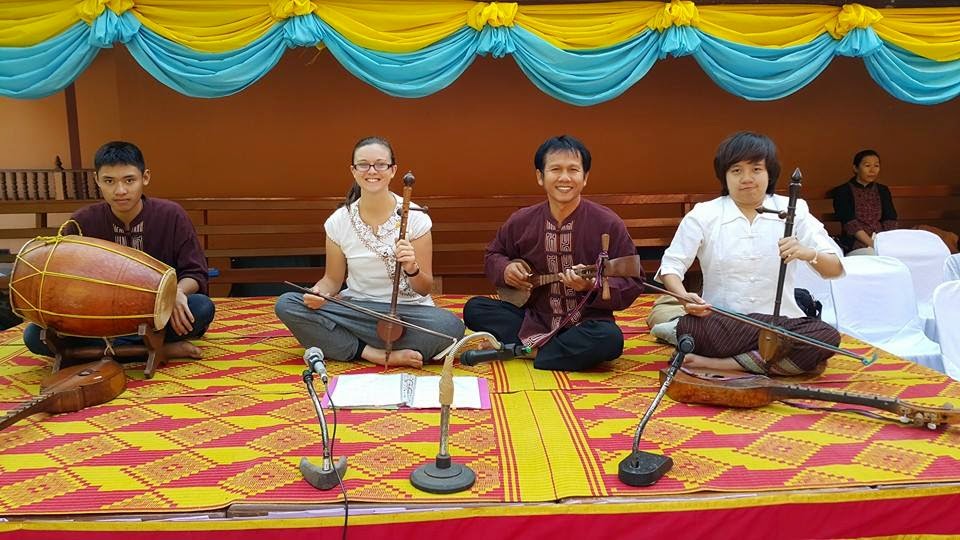
M5 student, Erin, Kru Peter, and a recent alumna perform at the abbot's birthday 
at Wat Phra That Pha Ngao near Chiang Saen.


Fortunately, I have been successful in learning a traditional Lanna instrument and performing; however, my initial views on music culture and education here in Chiang Saen were far off as I realized how prevalent orchestral instruments, marching bands, and jazz music were and how endangered traditional folk music is becoming. I was, however, pleasantly surprised with the interest in these genres of music and pleased that, like with other experiences abroad, how surrounding myself with music, both familiar styles and new styles, opened numerous doors for me to build relationships at school and in the community. 


I didn’t have to look very hard to find the opportunity to learn a Lanna string instrument. Having written about this desire in my Fulbright personal statement, the head of the foreign language department at my school, who teaches traditional Lanna folk music, was aware and eager to help me learn. He started by showing me the salor (pronounced: sah-law), a small, two stringed bowed instrument that is played upright while typically sitting on the floor. It is also known as the “northern violin.” 


Kru Erin and Kru Peter perform with an M6 student at open house.


After showing me how to properly hold the instrument and the bow, he demonstrated the notes by playing a simple major scale. At that moment I realized that the strings and finger positions are roughly the same as two of the strings on the violin. I quickly played a simple “ode to joy” on the instrument and surprised everyone in the room as my violin experience was previously unknown. Even though the hold of the instrument and playing techniques are very unique and these aspects would take me time and practice to master, producing the correct sounds came easily. News that I had played the violin spread quickly throughout school and by the next day I had a few students asking me if I could help them with the violin and the music teacher offering me a spare violin from his house to use for a few months. I never expected to find eager, young violinists here in Chiang Saen but was excited that the opportunity to engage with some students one-on-one in their comfort zone had presented itself to me.

Through meeting students to play violin, particularly one who I work with twice a week, the music building has become my second home at the school. Additionally, a week off from classes due to an unexpected administrative occurrence at the school allowed me to frequent the music building during that week and play trombone with the band students using the time off to practice. My attachment to the music room has further allowed me to establish a friendship with the band teacher, a teacher I otherwise may not have gotten to know easily. Although he knows a few words in English and I have a basic ability to communicate in Thai, establishing a relationship through verbal communication would have been difficult; music, however, has filled this gap. Typically, he will show me the music of a march or swing piece that he wants to work on with the students and ask me to play or sing the rhythms while he plays the drum-set. Not only do we both enjoy communicating this way through music, but it is also a lot of fun for both of us and allows me to share what I have learned growing up in interpreting and playing these popular American styles of music with my host community in Thailand.


Teachers from various departments play together during a day of class cancellations.

“Where words fail, music speaks (Hans Christian Anderson),” is the best way to describe how I have overcome language barriers in Thailand to develop relationships with teachers and students. Through music we share a passion and through music we can fill the silence that would otherwise exist, effectively communicating in this universal language. Most of the students I encounter through music are not students I regularly see in class, as most are not “English track” majors. Therefore, music has given me the opportunity to immerse myself deeper into the school’s culture, getting to know a wide variety of students and allowing a larger number of students the opportunity to work with and develop a relationship with a foreigner. 

Although many of these students are limited in their English abilities, they are learning how to effectively communicate through various means, mainly a combination of simple English and body language, when additional communication is needed to supplement music. Although I would love to see these children develop stronger English skills, I think it is valuable that these students are still learning several ways to communicate and are becoming comfortable engaging with a foreigner. Given that I never expected to be playing violin duets, brass band marches, and popular concert band arrangements in Thailand, I have been pleasantly surprised by the manner in which it has facilitated my integration into the school and allowed me to develop relationships with a variety of the students.

The salor has also opened many doors for me to become an integral part of my host community in addition to my school community. Coming to Thailand, I expected folk music to be very prevalent, particularly in a rural part of the country. The reality is that very few students know how to play these instruments and very few have an interest in learning. To many, it is a piece of the past, something considered “backwards,” and is not in line with the more modern, popular, and hip music cultures of both greater Asia and the entire world. In agreement with the head of my department, I believe that it is vital to preserve these unique cultural components of a society and I am hoping through my presence with the salor in the community and school to facilitate a desire to learn the traditional folk music. 

So far, I have been able to play with teachers from various departments during lunch and free periods and have been asked to play during school events with these teachers and the few students who do play. Hopefully, this will ignite a desire among current and incoming students to learn these instruments. The mentality of the head of my department is, if the foreigner can learn and play, why not you!? I hope that by playing both the violin and salor in the school with the students I can initiate and drive an exchange of music cultures and encourage students to become more involved in music, both traditional Thai folk music and Euro-American orchestral music.

Having previously only played traditional orchestral instruments in orchestral based ensembles in America and Europe, I will admit that I held the naïve belief that all aspects of the musical language were universal. The language that music speaks and that one hears is universal; the sounds produced remain the same across cultures, allowing people of diverse backgrounds to interpret them as a language. What I did not expect and what I was surprised by was that the written language of music, music notation, is not universal. During the first few days of learning the salor, I learned through listening and reproducing sound. After listening to the various teachers gather in the office and play together, I naturally wanted to join in and asked for a set of music notes so that I could read along. I was surprised and felt initially defeated when I was handed a book of sheet music with music notation that was written using the Thai alphabet and had no obvious distinctions between octaves, note length, and style.

At first I thought I would simply learn the songs by ear and write them out using the orchestral notation that we Americans are all taught in school. This, however, became tedious overtime and made me feel like an “outsider” in a culture I was trying so hard to be on the inside of. Even though I was learning the folk instrument, I was writing and reading in a “funny” script, to quote the Thais I played with, that was foreign and unfamiliar to my fellow musicians. In a sense, I was distancing myself from the culture by doing this. Eventually, I realized that not only would taking the time to learn to read the music help me advance in my ability to play and perform but it would also help me be fully on the inside of this art.

Learning to read the music was easier than I initially expected as I quickly realized the Thai characters corresponded to seven familiar scalar notes: “Do-Re-Mi-Fah-So-La-Tee.” I learned that the octave the notes are played in could be figured out through familiarity with the folksong or could be based on the preference of the player. The head of my department helped me decipher the other markings, such as note length, which is dictated through the use of dashes following a note. Now I am able to sight-read any piece in the book with few difficulties, which has allowed me to perform with groups in the community. 


Chiang Saen Wittayakom School's marching band in the Sports Day parade.


To me, cultural immersion and awareness is the act of learning and allowing oneself to be taught a particular aspect of a culture. In order to fulfil this while abroad, I desire to do more than have a presence in a community; I desire to become part of the community. The salor has facilitated my ability to do so given my limited Thai language skills and the cultural “shy-ness” of many Thais towards foreigners. Through performances at the school and the temple I have become a familiar face in the community as a foreigner who has genuinely cared to learn an aspect of Thai society. Not only are people intrigued by my ability to play the salor and my desire to learn, given that it is an endangered art, but they are also impressed that I have taken the time to learn their written script and music notation. The respect I have gained through music has helped me to establish a positive position as a foreigner in my small host community.

Even though I completed a semester abroad in Chiang Mai, Thailand, a few years ago, integrating into a small, rural Thai community has been more difficult than integrating into student life in a Thai city. However, similar to other international experiences, music has been my key to unlock the door to the heart of society. Not only have I been able to share my love for and expertise in music with students and teachers interested in Euro-American orchestral music, but I have been able to let myself be a student of music, learning a traditional folk instrument and becoming more aware of how diverse the language of music really is. When I return to Chiang Saen in May for the new semester, I hope to become more involved in making the traditional folk music more appealing to the students at my school.

30 March, 2015

Thai Acabemy (555)


A native of Arizona, Emily Foree, is an avid outdoors adventurer, slack-line enthusiast, and mediocre picture-taker. Currently teaching English in Phitsanulok, Thailand through the Fulbright Program, Emily hopes to continue fostering her passion for traveling while focusing on her interests in community development, ecology, and environmental issues. Emily's narrative explores an unexpected and surprising language classroom in Thailand.


Thai Acabemy 


The Thai language is intimidating. After just one week of language lessons, my Thai was minimal at best. Simple statements like “yes” and “no” were just beyond my grasp, and I was trying as hard as I could to end each sentence with a polite and expected “ka.”


One afternoon during our orientation month in Bangkok a few fellow ETAs (English Teaching Assistants) and I decided to visit the Grand Palace, the former official residence of the Thai monarch. The complex houses a number of noteworthy buildings, including Wat Phra Kaew (the Temple of the Emerald Buddha), which is breathtakingly beautiful—lots of gold leaf. If you are unfamiliar with Bangkok, this is arguably one of the most popular tourist destinations in the city. We hailed a taxi not knowing it was about to become our most valuable classroom.


Having just learned important taxi-taking vocabulary, we were eager to practice with our driver. He laughed with us as we butchered tones and pronunciation, but somehow managed to decipher our request. Slowed by never ending Bangkok traffic jams, and wanting to continue the playful atmosphere of communication we had created, we began yelling out any and every word in Thai we could remember. “What…name?” we inquired in broken Thai, effectively achieving our desired introductions. 


Bangkok traffic.


Our conversation quickly turned to shouting as the four of us competed to use our new vocabulary. We laughed, asked our driver where he was from, shouted "ma muang!" (mango!), "tuah fak yow!" (green bean!), "nam blah!" (fish sauce!), pointed out things that were “suaay mak mak!” (very very beautiful!), pointed at things that were “see chompoo” (pink), attempted to say we liked spicy food, told him we were teachers, and talked a lot in general, considering we really did not share a common language, and it was an all-around positive cultural exchange. "Sanuk! Sanuk!," we shouted, noting the fun!


Our conversation was fueled by laughter and maintained by a mutual desire to connect despite a significant language barrier. Even though we spoke little to no Thai, and our taxi driver spoke an equivalent amount of English, we learned each other’s names, discovered that Pi Jo was originally from the Northeastern part of Thailand (Khon Kaen, to be specific), and that he had two children, a son and a daughter. It was evident that our playful approach to using Thai and communicating was well received and created an open road for practicing a wildly difficult language—not just for us, but for Pi Jo as well. 


ETAs Krista, Emily, Griffin, and Ned at Wat Arun.


At some point along our ride to the Grand Palace, while waiting at a traffic light, Pi Jo opened his door and called to a woman selling bags of food on the street that were unidentifiable to our foreign eyes. When Pi Jo pulled out 20 Baht and bought a bag, we figured he was just a little hungry and wanted a snack for himself.


Wrong.. 


Instead, he was buying a bag of fried bananas to share with us—some khanom, the Thai word for “snack.” He told us, in far fewer words than I now write, that this particular type of banana-snack is his favorite, and he wanted us to try them. The bananas were absolutely delicious, but that is not why they are (and will remain) my favorite Thai dessert. More important was the implicit communication that was expressed and received through our first silent moment with Pi Jo. This small action was the nicest, most genuine moment I had shared with anyone thus far, and it really gave me an insight into Thai culture. Although I have experienced countless moments of unbelievable courtesy and compassion since arriving in Thailand, this memory will always stand out to me as the moment I felt entirely capable of making meaningful connections with people despite an inability to fluently express myself.


Adding some transportation words to my vocabulary greatly altered my experience in Bangkok and in Thailand. Taxis had previously caused me a certain level of anxiety, considering the worldwide sentiment that Taxi drivers generally take advantage of tourists by refusing to use their meters and exorbitantly inflating prices. Some Bangkok drivers would try to take me to various scams, and others would drive in frustratingly roundabout ways to my desired destinations. However, as soon as I began using even a little bit of Thai this all changed. By greeting others with a respectful “sa wat dee ka” (hello) and appropriate “wai,” I am able to express my desire to engage with Thai culture, and this effort continues to be appreciated by every person I meet. Taxi drivers are no longer anonymous beings, but temporary friends who I can exchange a few meaningful words with, or maybe even share some fried banana.


Shayna and Emily with host teachers in Mae Hong Son Province.
After spending a month teaching in Phitsanulok, I stepped into a taxi for the first time. The ride was over an hour long, and to my surprise I found that I was able to converse and communicate with my driver for nearly the entire time. An activity that had once given me anxiety had become the most accurate measure of my linguistic progress.

12 March, 2015

Orbiting Vowels


Kayden Hoang Bui is a recent cum laude graduate with a B.S. in Biology and B.A. in Mandarin Chinese from the University of St. Thomas, a small private Catholic university, in St. Paul, Minnesota. He is a 2014-15 Fulbright English Teaching Assistantship in Sukhothai, Thailand. At his placement, he teaches M1-M6 (6th thru 12th grade) students, and during his free time he likes to eat French fries, journal, and drink iced coffee. In five years, he hopes to graduate from a Masters in Public Policy program to continue his journey towards being a Foreign Service Officer.


I greatly enjoy learning Thai. I’m not too sure why. Maybe it’s because I like to be constantly frustrated. When I understand Thai and when I get to learn new useful/funny words, I love it. I get to use it in class with my students to make them laugh, and I get to connect more with the people seeing food at the market by using more vocabulary to learn about their days and life.

I found my predilection for learning languages early in life during my Sunday school years. As an immigrant living in Minnesota, you can imagine how my mother was afraid I would lose the language that lay most closely to her heart. I went to Vietnamese/Catholic study classes for two hours every Sunday, learning the Vietnamese alphabet and the Bible.

Vietnamese seemed first nature to me because it just seemed so simple. After all, after the French and communists got a hold of the language, there was a big reformation and simplification. But after three years, my teachers were still teaching our 29 lettered alphabet and the differences between our three “a”s to my peers. It was pointless for me to be there, so I made my first big decision in life: I decided to dropout*.

The next time I found a love for languages was in 2010 when I became the first student from the University of St. Thomas to study in Bangkok. I chose Bangkok because there were only so many choices for me to fulfill my pre-medical/biology requirements while also abroad.

It was the first time I realized how beautiful learning a language can actually be. Learning biology or learning physics was incredibly difficult at times, but at the end all I received only mostly knowledge I could use with cells and pulleys in a lab.

But learning Thai was different. It was a language that quickly became my second language for communication with the shop keeps and people I meet on the street. Though at Mahidol, my hosting university in Bangkok, only offered Thai 2.5 hours a week, so I found extra lessons through speaking with new local friends.

After I came back to the United States, it was another four years before I would speak more than a sentence of Thai.

In 2014, I was blessed to receive the Fulbright to Thailand. From there, I hit the ground running. I opened up the Thai books to get in as much vocabulary as possible, I tried to speak it as much as possible throughout the day when I’m not with other Fulbrighters. It became much easier for me to communicate if English wasn’t available as a supplementary language. I am constantly learning new words, learning to read and write the alphabet, and teaching English to people using their native language.

I have come to conclude that language is a special beast. Intimidating and almost evil if you are not familiar with it, but is a friend and your most powerful ally if you take time and care for it.

Learning Thai is crazy for many reasons. But the three main reasons are: 1. It may be uncommon for a Thai person in your respective town to speak English well enough to explain why Thai words are used that way or the shades of meaning among them, 2. The writing system is dizzily complex where the vowels go behind, before, above, below, or surrounding a consonant like planets in orbit, and 3. Thai tones and vowel length are sometimes perceptively so minutely different.

I’ve had tons of moments where I would speak simple phrases in Thai, and the merchant would look at me as if I was asking to buy a zebra. Then after moments of pointing, they would go, “Ohh!” Then would proceed to say the sounds I thought I produced initially. It’s frustrating.

But it’s fun!

Learning the language and connecting people with it has definitely been my favorite part of being in Thailand so far, and teaching English is a close second.

I’m not sure of the reason why I like to learn languages so much—especially Thai. Maybe it’s because I’m motivated by something internal, like my need to connect back to Southeast Asia after my family immigrated to the United States in 1991. Maybe it’s an external factor where I am able to get to more places, do more things, and meet more people by learning it. Or maybe I like to be challenged by the 6 different “th” sounds and the nasal and glottal stops.


But whatever the reason, I can solidly conclude that learning Thai and being here with my students have been one of the most rewarding experiences so far in my life. I feel accomplished after learning a new word, like small peaks in the middle of my day.

This a fellow foreign teacher (from the Philippines) and I with some of my students. They are proudly displaying the game they created for the international languages exhibition for my class. 

I’d like to think that my students and I share a common struggle to speak a new language, and that the bond makes our relationship just that much more special. And it definitely helps my motivation when the local shopkeepers give me extra food here and there because they think my Thai is “cute.”

Contrary to many foreign language instructors, I don’t believe in fully using the foreign language to teach unless you live in an area that speaks that language. Creating an English only environment in a Thai classroom in the middle of a rice field is not realistic and is not the most effective. Superficially, it makes sense because what’s faster than 100% of listening only to English?

If I had tried to speak only in English, it’s not only frustrating for me, it’s frustrating for the student, and then both parties are now frazzled and looking forward to the end of the “conversation” which would mostly be made up of both people perpetually explaining the previous sentences.

As a foreign English teacher, I have two main jobs, and teaching English is only my second job, and it cannot be done without the first. The first job of any foreign English teacher—is to build up the students’ self-confidence.

Without self-confidence, the students cannot and will not speak more than a couple sentences at best.

This was fully demonstrated while I tutored one of my M6/1 (12th grade) students—Praew. She is a young woman who rarely spoke up in class, but got very good grades on homework assignments and exams. One day, I encouraged her to apply for a scholarship for an opportunity to go to America, and she was ecstatic that I asked her. At first she was struggling with speaking English, but her vocabulary was there. When I would say a new word, she would translate it into Thai and asked me if it was correct. Often times I would understand her, and I would either confirm or help correct her. Knowing and speaking a small portion of the Thai language helped me build a very strong relationship with her.


Skating with my students as a treat after the interview in Bangkok. 
We spent hours every week talking, writing, and with me asking her questions about her goals and her aspirations. Her self-confidence was boosted every time we met.

And even though she did not get the scholarship, she spoke up more and more every day in my English class. Joking around, explaining things to other students, asking me questions, and just everything else that I hope all my students could be. She was energetic, curious, and was not afraid to make mistakes.

This could not have been possible if I spoke only in English in class because she would be scared initially, and my English would intimidate her. Because of my initial Thai with her, I’d like to think that it broke the ice and allowed her to become a better and more confident student.

I am still working at both my goals one student at a time, but I know that learning Thai and continuing to be passionate about the language is the best way that I can achieve both of them.


Some of my students made it to the U.S. Embassy for the Southeast Asian Youth Leadership. 
*During undergrad, I went back to my church school and became a Vietnamese kindergarten teacher.