17 January, 2017

Dance with Teacher Sara, the cha-cha in Si Racha


Sara Guido is from Long Island, New York. She graduated from the University of Miami in 2016 with a B.S. in Elementary and Secondary education, and minors in Spanish, Italian, and Dance. She is a 2016-17 Fulbright-AMCHAM ETA at Ban Bowin School in Chonburi province. When she is not teaching, Sara enjoys scuba diving, trying different Thai foods, practicing yoga, and exploring her province as well as other cities in Thailand. After Fulbright, she plans on pursuing her master’s degree and teaching in the United States. 


“Dancing is just discovery, discovery, discovery.” ~Martha Graham


I grew up in a house full of music. While never a musical prodigy myself, my father is a musician and I always associated music with happiness. When going to a foreign country where you don’t speak the language, people often tell you that a smile represents a universal language. However, many people don't realize that music and dance can also be shared and understood as universal communication. In the past four months, I have found that Thailand is full of music and dancing. If anyone wants to disagree with me, they clearly have never been to a Thai party!


Selfie with Mattayom 2


My school hosted a party for the associate director who was transferring to another school. At this party, we celebrated by dining, giving gifts, and relaxing. It seemed as though it was like any going away party would be in the United States, with one exception. As soon as the party started, so did the karaoke. While I’m not a huge singer myself, I watched as my teachers belted out popular Thai songs and owned the stage. After declining several requests to sing any song I wanted, I watched as some of the teachers supported each other by going up to the stage to be back-up dancers for the teachers who were singing. I went up and danced to Isan music that I had never heard before and had a blast. It was so much fun getting to know teachers from other departments, which may have never happened if it weren’t for dance.


I am grateful for the chance to teach 800 beautiful students ages 8-15. They are enthusiastic, intelligent, artistic, spunky, and most of all, loving. Teaching these students makes me a happier person every day. Teaching this wide span of grade levels in the same semester is a challenge, but one that I am fortunate to be able to undertake. I am able to sing songs and play games with my prathom 2 (2nd grade) students, while I’m able to have discussions with my mattayom 3 students (9th grade) students about their goals and what they want to do when they finish school. Each grade presents me with new challenges, yet gives me very rewarding experiences. These students make me smile and laugh, teach me Thai, and remind me what it feels like to be a kid again.


Prathom 6 students holding up the "U" for the University of Miami


At my time at the University of Miami, I took a course with the amazing Professor Kaminsky, which was titled, “Teaching Dance to Children.” When filling out my Fulbright application, I wrote that I would love to involve my community and students in dance. Everyone loves to dance, though everyone may not admit it. “I can’t dance” is something you will hear at every middle school dance, but it’s not true. Everyone can dance, and everyone should!


Prathom 3 preparing for the Christmas Celebration


Tuesday afternoons are my favorite at Ban Bowin. The last period of the day is a “club” period and I get to lead dance club, also known as “hip hop” club, with 20 prathom (primary) students. It was started the year before I arrived at school, and the students were thrilled when I decided to continue it. We meet for 50 minutes and practice for events, such as the Christmas celebration. We make music videos, or simply have a dance party to enjoy the afternoon. While this time is about dancing, it is also about relaxing and having fun. I get to interact with my students in a totally different way than I would be able to in a traditional classroom setting. We compare artists (Justin Bieber always wins, with the students’ favorite song, “Baby”), take selfies, and I am able to get to know their individual personalities in a way that simply cannot happen when you have 45 students learning in a classroom. We also are able to learn new words that we wouldn’t in class. I’ve learned words in Thai and taught my students words in English related to music and dance, and I love the way we are able to communicate with our combination of English and Thai.


I was so proud watching my students perform for my school’s Christmas celebration. They all took the time to coordinate by wearing all black, wearing matching hats, and even put on some makeup so that they would look like performers. They truly shined on the stage. My students may not be learning traditional dance, ballet, tap, modern, etc. They are learning important life skills: how to be a part of a team, how to help each other and be kind, and most importantly, how to have fun and be themselves.


Dance Club after their Christmas Performance


One of my favorite memories so far this school year is Scout Camp. For those who don’t know, Scout Camp is when the high school boy and girl scouts go to an army base and learn valuable skills from the local military such as how to cook food and hike. It is a wonderful, unique, and fun learning experience for these students. They are very interested in learning outside of the classroom, thus enhancing their learning experience. On the last night of Scout Camp, there was a celebration for the students to congratulate them on what they had learned by throwing a dance party. I had so much fun listening to the music and dancing with my students. They even taught me a little bit of the Thai traditional dance hand movements. With my students becoming the teacher, I am able to understand their thought processes and how they learn. I have found this exchange of information between myself and my students, through both language comprehension and dance, to be a useful tool in recognizing the best teaching methods to use in the classroom setting.


Selfie with Mattayom 3 students at Scout Camp


I am here in Thailand to teach the English language and American culture. However, my ultimate goal at the end of this year is not to have my students fluent in English (while that would be pretty great!). Instead, my goal at the end of this year is to make learning English fun. I want my students to know that they are loved, supported, and that they each have a bright future ahead of them. I want them to discover what they want out of this world, and strive to realize their dreams. I want my students to embrace the learning of new information and languages in the same way they enjoy music and dancing, and to understand that there is happiness in every minute and every day.


“I do not teach children, I give them joy.” ~ Isadora Duncan


05 January, 2017

It’s the Little Things


Linda Mathew is a 2016-17 Fulbright-AMCHAM English Teaching Assistant (ETA) at Rajapracha Nukroh 8 School in Nakhon Si Thammarat Province. She is from Long Island, New York. She graduated with her BA in Elementary Education and Psychology and later completed her Master's in Teaching English to Speakers of Other Languages (TESOL). When she's not lesson planning, she enjoys trying out new food and exploring her town. After her time as a Fulbright ETA, Linda plans on teaching English in New York, or wherever her wanderlust takes her. She hopes to one day write children's literature to promote understanding of educational systems from around the world.


It’s the little things.

I sit here with the rain drumming outside my window, tired from all the brainstorming I’ve done for my upcoming lessons. The past few weeks have definitely been tough ones. I have made many accomplishments that have me beaming with pride, but to another extreme,I have also found myself questioning my abilities, giving into frustration and feeling like a failure. I think this is the most relevant description I can give when it comes to putting my feelings into words.

Being a Fulbright ETA requires us not only to teach, but to be cultural ambassadors. With my teaching background, it’s sometimes difficult not to be so hard on myself about the educational aspect when the cultural educational aspect is important too.

There are days where I feel so defeated that I can’t comprehend what I am doing wrong. During my self-reflection process, I had to define what it meant to be a failure. After taking time to dissect what was dictating my emotions, I realized that it was things that I had no control over that were bringing me down! I realized that harboring negative energy was not very culturally parallel and that by focusing on the little things, I would find myself in a better place. After all, the big picture is made up of all the little things! I had to embrace the sabai sabai* lifestyle a little more and let go of wanting to control everything. The sabai sabai lifestyle is similar to having a “go with the flow” attitude. This cultural norm that I am trying to adopt into my lifestyle has drastically improved the way I see and approach my ability to teach and interact with my community.

I would often find myself feeling defeated when after spending hours on a lesson, a student could (maybe) say one vocabulary word. Full of defeat and frustration, I would trudge on with the lesson, doubting whether I was even making an impact. Then one day, I was calling out names via name tags (for attendance), when a student beside me said, “Teacher, Aartip, ::cough:: sick.” It was exactly the way I taught them feelings and in the most appropriate context. It may not have been all 28 of my students, but it meant the world to me.


My school's field trip


It’s the little things.

“Good morning teacher,” followed by Anubahn (kindergarten) students running with open arms ready to clasp themselves around me. When I’m free, I try to teach the kindergarteners a song or two. Whether it’s teaching them the “English” version of “If you’re happy and you know it,” or animals with “Old MacDonald,” their enthusiasm is what energizes me! After naptime, I walk to one of the kindergarten rooms as the children wake up from their slumber. Once the teacher says, “get ready for songs with Teacher Linda,” the children bounce up to wash their faces and line up to sing with me. Even the students from the other classes run in to join the party! Feeling this kind of love while singing the simplest of songs is hard to beat.


It’s the little things.

Anubahn Love

Being a part of my community has been something I’ve been so excited to do. With my limited Thai, I was told to introduce myself to the whole school during Parent Teacher Day. Nervous, I found my way to the microphone to fumble out the Thai I had been practicing over and over again since I stepped off the plane to Nakhon Si Thammarat. “Sawatdeeka! Chan chue Linda na ka. Chan gum lung rian pasa thai dtae puut pasa thai dai nid noi. Kor tot ka mae rue puut pasa thai mak. Bpen kru pasa angriid na ka. Ma jaak Amerigaka. Chop sawn ti rongrian Rajapracha Nukroh 8 na ka. Kopkunmak naka.” Very loosely translated, “Hello, my name is Linda. I am learning Thai but I speak very little. I am sorry that I don’t speak a lot of Thai. I am an English teacher and I am from America. I like to teach at Rajapracha Nukroh 8 School. Thank you.”

As embarrassed as I was at my mediocre Thai, I didn’t realize what an impact that had with the parents. After a few claps and giggles, I later found out that parents expressed being more comfortable with approaching me outside of school because I “spoke a little Thai.” I even got a thumbs up from a dad sitting in the crowd as I sat down!


It’s the little things.

Huge turnout for Parents’ Day! 

Classroom management has never been my forte; throw in a language barrier and I figured I might as well wave my white flag now. As I took the opportunity to learn more about my school and the way classes are, I witnessed my students acting just the same in their other classes. It’s refreshing to realize that troublemakers are universal, and it’s not just in Teacher Linda’s English class that boys rough-house and girls giggle in the corner. Obviously, I can’t express my feelings with the students in their language, so facial expressions have been my only support. One day, during a very rowdy P4 class, I stopped talking and expressed my discontent with their behavior through my silence and piercing eyes. Then from the front of the class, a whisper,


“Angry.”


I couldn’t help but burst into laughter and say, “yes, angry,” feeling more triumphant about his use of vocabulary than anger.


It’s the little things.

I didn’t realize how difficult it would be to go through the holidays without my family and friends.

I was feeling a bit sad and lonely, but my community didn’t allow me to wallow in those feelings. My host teacher and family took it upon themselves to research and find a local church and attended the entire service with me. At dinner that evening, she turned to me and said, “In America you would be eating dinner with your family, so today, you will eat dinner with your family.”


It’s the little things.

My Thai family


The pace of life here is pretty different from the hustle bustle New York lifestyle I am used to. People do their own thing at their own time. I had always approached teaching with the mentality that I had to finish everything that I planned. Adding the fact that I only see my students once a week for maybe an hour increases pressure exponentially. I am learning to take things slower and acknowledge that every interaction
be it big or smallis an exchange of ideas, knowledge, energy and culture. 


At the end of the day, 

it’s the little things that bring a whole lot of happiness.


31 August, 2016

An Ode to My Students


Elizabeth (Edie) Wilson is a 2015-16 Fulbright-AMCHAM ETA at Muang Chaliang School in Si Satchanalai, Sukhothai, Thailand where she teaches students in Mattayom 1-Mattayom 5 (Grade 7-Grade 11). She graduated from Hamilton College with a concentration in Anthropology and minors in Economics and Government. Prior to coming to Thailand, Edie worked as a Research Assistant at ICF International studying the effectiveness of US education programs. In her free time, Edie can be found running through the rice fields, writing in her journal, attempting to decipher Thai, drinking green tea, or eating yummy Thai food with fellow teachers.


Introduction


Thailand has given me so much. So much love. So much life. So much food.

I cannot even begin to successfully express my gratitude to Thailand or all the wonderful people who have made it home to me. I will never be able to fully describe all of Thai culture I have learned about this year—from large life-changing experiences to tiny nuances. In this chunk of text, I do hope to express my thankfulness for my greatest teachers (and cheerleaders in my quest to learn Thai), the Muang Chaliang School students.

While teaching at Muang Chaliang School, I’ve noticed the way that students show both reverence and respect for teachers in a way that I haven’t seen in the United States, along with breaking down boundaries of the teacher-student relationship. Students thank teachers after every class. They help get teachers lunch and move desks around the classroom. They braid teachers’ hair and play with the office cat. Teachers visit students’ houses and chat with their parents or grandparents.

The way teachers and student interact in Thailand feels like a family relationship to me. To support this claim I can say, without a doubt, that the students and teachers at Muang Chaliang School have become my family this year. So I let me tell you a little bit about my family.


Posing for a photo during teacher home visits with M2 students. My students live in a variety of different living conditions. Some students live around the corner from school in the village, while other live thirty minutes away among big rice fields like this one.


Arrival


The first day feels like I am watching a movie of my life take place with little control or knowledge of what will happen next.

Filled with a flight and multiple van rides. Get on, get off, get on, get off. Take a photo. Meet the director. Look around the school.

“Hello!” A student calls. I assume he’s a student since he wears a bright pink uniform shirt and navy blue pants with MCL stamped down the side. He knows me before I know him. I don’t know what the appropriate way to respond is. Do I wave? Do I wai? Do I say hello back? Sawatdee kah? Kah? Hi? Hey? Yo, wassup?

I’m supposed to be the teacher, a leader, and I already am at a loss for words.

“He said hello,” P’Oy, the Fulbright representative who has been designated to go with the Sukhothai ETAs on our first day, looks at me expectedly. I take a deep breath and go for the wave.

“Hi,” I smile. He smiles back. From that moment I become the waving teacher, and my students greet me with a wave and a melodious “Hello” or “Hi” whenever they see me.


Laughter


I’m scared, but more confused than scared. It’s my second day in Si Satchanalai. I think I’m supposed to observe today, but I keep getting lost looking for the”M1/1” class that I’m supposed to attend. I walk along the long outdoor hallway peering into classroom after classroom. Some students stare back.

“Teacher, can you speak Thai?’ A little girl with a bowl cut bounds up to me.

“Pasa Thai nit noy” At that point, I’m pretty sure those words, along with hello and thank you are the only Thai phrases I have memorized. And that one is actually not even a full phrase.

She throws her head back and lets out a hearty laugh. Not unfriendly. Simply, loud.

I learned that her name is Mew, and she is without a doubt the most enthusiastic student I meet. Every time I see her around school she yells, “TEACHER!!!” and runs up to me. Sometimes, I’ll be writing on the board, and I will look back to see Mew standing on a chair, waving both hands in the air, ready to respond to a question. Then I call on her. She gets so excited that she forgets what she was going to say. I wait for her to remember. She laughs that hearty laugh at herself. A few seconds later, she remembers and shrieks her answer. I learn to laugh at myself full heartedly from Mew.


Hugs


It’s February, and I miss my sister. I miss her a lot. I miss her kicking me out of bed to watch the sunrise. I miss her dancing around to When Your Best Friend’s All Strung Out. I miss her hugging me. I walk outside to go buy cookies at the school store. Two tiny girls run up to me and wordlessly throw their arms around my waist. I feel so thankful.


Crossword


“Will one student raise his or her hand to read the questions?” It’s a ritual at the beginning of each class. At first I read the intro questions, but a few weeks ago I passed off the duty to my eager students. There’s a smart, outspoken boy who always volunteers. I see his hand shoot up. I smile. Someone new today. When I don’t call on him, it’s like the parting of the red sea. Everyone turns his or her head to a girl in the back, right corner. “Yeen” “Yeen” “Yeen” they whisper. A girl who has been quiet up to this point stands up and comes to the front. She reads flawlessly. I feel like I’ve missed something as a teacher for not seeing her more clearly sooner.

The next day, after school, Yeen comes to the classroom, three girls looking less than enthusiastic are in tow.

“Teacher, I want to play Crossword.”

I look at the Bananagrams bag resting on the corner of my desk that she is motioning toward.

“Okay.”

Two of the other girls join us. One laughs and shakes her head no. She looks at the stack of student work with which I’ve begun decorating the back of the room. Then she goes to the back and begins taping papers for me.


M3 Graduation Day for some of Crossword players. My school celebrates graduation for M3 students 
moving up to M4 and for M6 students leaving school for university or work. 


Yeen often comes to the room after school with a group of girls. She always wants to play “Crossword”. And she’s good the game, often thinking up words I don’t see at first.

Yeen is one of the few students I keep for a second term, and in the new semester our ritual of after school Crossword continues. Sometimes, she brings friends. Other times she shows up in the doorway alone. Many times, she will come when I’m in the middle of grading papers or checking attendance against stacks of nametags.

“Teacher, are you busy?”

“Oh no,” I drop whatever I’m doing because spending time with my students is always of greater importance to me than classroom organization—and more fun.

“I distract you,” Yeen laughs at my eagerness to forget my work.

Playing Crossword with Yeen is also an ongoing Thai lesson for me and English lesson for her. We never play for points against each other—it’s always a joint effort to come up with the most words together. Practically every word I ask her…

“How do you say this in Thai?”

When she doesn’t know the English word, we whip out Google Translate to find our answer.

We share our desire to speak each other’s language, as well as our frustration.

“I don’t speak Thai well. I want to speak Thai well,” I tell Yeen in choppy Thai, exasperated with my own inability.

“Teacher, I want to learn English. I cannot speak English well,” Yeen empathizes in English. Her English definitely outpaces my Thai though.

Through our Crossword interactions, I continue to get to know Yeen. She tells me her favorite class is English, and she wants to be a policewoman. I have no doubt Yeen will keep the people of Thailand safe.

Yeen teaches me about the true friendship that can be formed across age, language, and culture.


Selfie turned Class Portrait


We finish class laughing so hard that a few of us are close to tears. I don’t remember what it’s about, but most likely it was I, trying to translate something into Thai and failing miserably. You see M4/2 has taken it upon themselves to be my 30 plus personal Thai tutors on Friday afternoons. I teach them a new word in English, and then they teach it to me in Thai. I’m learning a lot, but sometimes I mispronounce a word so horribly, that something very inappropriate comes out.

I regain my composure. “Please collect the nametags, and give them to me. Thank you. Good Bye. See you next time.” I complete my standard class closing.

Students bound up to me with stacks of nametags in hand. One girl pulls me aside.

“Teacher, selfie.”

Since the first day, students, teachers, random strangers in the marketplace have asked me to take photos with them. Photos have so much become part of my life that I myself don’t think I go a day without catching a snapshot.

I lean down—all of my students are shorter than me.

“No…sun....” She trails off into quick Thai that I don’t understand, but I allow myself to be turned around, and pushed between more girls. She shakes her head, unsatisfied. Then gathers everyone who hasn’t already left the class and takes us outside. Two girls take my hands and lead me down the stairs as though they are leading a blind puppy. On the way the girls shout to the students who are heading off to their next class in Thai.

“Come quickly!”

The students survey the situation, trying to choose the most appropriate backdrop and settling upon the white wall of Building 1. They recruit two timid looking M1 students, ordering them to take a good photo and not mess up. I find myself in the middle smiling authentically through a series of serious to silly class photos.


M4/2 pose for a spontaneous class photo after an hour filled with English learning.


The class photo shoot makes me feel honored and accepted. M4/2 teaches me that a class can be a family.


Around the Track


The school track is my front yard. I spend a good amount of time running, walking, and staggering around it. In the evening it is often a slow walk that starts out with my ear buds playing Coffee by Sylvan Esso or Ezra Klein’s latest podcast. During every walk without fail, the ear buds come off. I strike up a conversation with a local elementary school teacher, make friends with a baby, or am joined by my friend, Bom, for gossip time. It was on one of these evening walks that I met Frank.

I’m walking along, listening to music, when she bounds up.

“Hello!”

“Hello,” I smile.

She starts talking in very fast English, like she already knows me. She doesn’t even start with an introduction. However, I’m sure I haven’t seen her in any of my classes before. I have to check to make sure though.

“What class are you in?”

“5/7”

Okay, I don’t teach her, but by the end of our conversation I know all about her extended family, her hopes to travel, and how she ended up moving here from Bangkok. You see, more than just her amazing bilingual ability, Frank has this way of making you her best friend in a matter of seconds. Her body language, her familiar tone, and her frankness make her an instant companion. She helps me translate. When something bad happens at the school, Frank tells me, without hesitation and without sparing any detail. When she sees me, Frank runs up and pokes me or taps me on the shoulder—a gesture of familiarity that makes me happy.

Frank shows me that being unafraid is the best way to connect with people.


Closing


I could continue to write all day about my wonderful students. About Ice and other M2/3 students teaching me Isan dialect and trying to get me to sing the school song. About playing Simon Says the one brutally cold week in Thailand with M4/1. About conversation exercises with M3/6. But I’m afraid your eyes might be getting tired.

I’m worried that leaving Muang Chaliang School will feel like moving out of my hometown to go to college all over again. Brutally emotional. Ranging from excitement for the next chapter to sadness for not seeing the faces I’ve come to know and love every day.


Students gather around the bulletin board posting warm fuzzies-kind English notes-to teachers and peers
 for a Valentine’s Day lesson.


Emotions aside, I will leave with two important lessons from my students. Firstly respect and familiarity are not mutually exclusive. Secondly, a community can form the 
truest of families.


17 August, 2016

Let’s Take A Selfie


Christine Fortner is a 2015-16 Fulbright-AMCHAM ETA at Thaikasikorn Songraw in Si Racha, Chonburi, Thailand. She is from Charlottesville, VA and graduated from Elon University a year ago with a degree in Education. Christine loves to travel and explore and has been to 6 continents. In her free time, she enjoys making new friends, running, and exploring the beautiful beaches around Chonburi. After Fulbright, she plans to move to Washington DC and pursue a career that makes a lasting impact on the world of education.


“Sure! I’d love to take a selfie.” These words have come from my mouth hundreds of times over my past ten months in Thailand. Everywhere I go I am noticed. Smile and wave! I feel like a superstar. Selfie is a word every Thai person knows, and a word that has brought me smiles, laughs, and community. Throughout my last year in Thailand, I have found that the phrase “Let’s take a selfie” and social media can be a bridge in language and cultural barriers.


My host teachers and me at Bang Saen Beach
 
Getting ready for Teacher Day


On my first week of school, I walk home and pass an older man sitting on a bench. He calls out hello and motions for me to come sit down. Totally normal.

“Take selfie? Ok?”

I take a picture with the man and think nothing of it. I sit down and am surprised by the English he knows. He is asking me where I am from and what I am doing here. It is my first week, and I am in no position to pass up any kind of friend. I engage in conversation and sit with him. Saying yes to selfies in Thailand is very important. It is an invitation to be make a friend and opens a door for cultural exchange. Little did I know that this particular selfie would lead to an amazing community right next door.

For the next week, I walk by this old man every day to and from school. We take silly pictures together and I even teach him how to play a card game. He quickly becomes one of my best friends in a place that feels very lonely. He speaks some broken English, but we find ways to communicate. That week I am introduced to his family and asked to teach their children each night. Thailand has taught me many things, and one important thing is to say yes in random situations, even when it feels out of your comfort zones. I agree to teach at their house in the evenings, and it quickly becomes one of my favorite things in my new home. The first time I go out with my neighbors, we take a group photo. That night the picture was posted on Facebook and captioned “my family.” While it was a small thing, the affirmation of seeing myself standing in their family picture meant a lot. From that moment on, I have truly felt like family with them. I eat dinner with them, travel with them, and am invited to every family event. What started with one picture and Facebook post has turned into a lasting community and family. 


My mom being introduced to my Thai family


This year with large cultural and language differences, I have had to redefine the word community. I find community here in so many different ways. Whether it’s the lady I smile at when I buy my daily dose of pineapple, the lady who sells me chicken at night and tells me I’m beautiful right after I went on a run, the man on the bench who brought me into his family, or the teachers at my school, I have found a way to feel like I belong in a place where I am so different
. Social media allows me to talk to people with few words. I can have an entire conversation made of stickers and emojis. No words needed. No language barrier in the way. I can comment on a teacher’s Facebook post and tell them they look beautiful. I can give likes, hearts, and stickers to affirm relationships I have made. It is very small, but it creates connections and allows a little part of the wall to break down.


Teacher Drummy and me are always ready for a selfie.


Making silly faces, funny poses, and looking weird are ways to connect and look beyond physical and cultural differences. It fills the silence and replaces the frustration of not being able to communicate with fond memories. What started with little moments of taking selfies or posting on social media, has turned into higher comfort level and allowed for deeper conversations and understanding about our different cultures. You don’t realize the power of language until you have to be intentional about everything you say. When people see differences, they automatically put up walls. This year I have used the silliness of selfies to break down the walls put up by language. I have used this to start forming connections and make people feel more comfortable around the girl who looks different. Being silly in selfies and social media allows my Thai friends to open up and feel comfortable with me. It shows us that despite our differences, we are the same in so many ways. We all love to laugh. We all love to be goofy. And we all love a good selfie.


Selfie on my way to school

Selfie at Scout Camp
Even my students love a good selfie


11 August, 2016

Narrative: “How was Thailand?”


Meg Ziegler is from Rhode Island and graduated from the University of Vermont last spring. She majored in Secondary Education with an English concentration and minored in Special Education, all of which did little to prepare her for the amazing and challenging experience that is teaching English as a foreign language. Meg is a 2015-2016 Fulbright-AMCHAM ETA at Ban Phai Pittayakom School in the Khon Kaen province in northeastern Thailand. This year in Thailand has given Meg new friends, a wealth of elephant knowledge, a much higher spice tolerance, and an expanded worldview, something she hopes to bring to future studies in either education policy or education law.


Now that it’s August, the inevitable return to America is right around the corner. The date is set and the flight is booked. It feels like just yesterday I was sitting in orientation, terrified and excited for what the coming months would hold, and now I have those same feelings as I am faced with this year in Thailand coming to an end. Going home means saying goodbye to wonderful new friends and reuniting with old ones. It means dealing with the reverse culture shock of five-dollar bagels and clean tap water and driving on the right side of the road again. It means no more rambutan and far less sweating. And it means being asked over and over and over again, “How was Thailand?”


What a loaded question this is. I am faced with the problem of adequately describing my year in a foreign country in one single answer.


Harvesting rice alongside my students.


I suppose I could answer with a generic “It was good!” or “It was great!” This might suffice for the occasional acquaintance from high school that I run into at the local coffee shop, but for my close friends and family this answer does no justice to the absolute roller coaster this year was. “Good” and “great” do not express how difficult it was just to teach my students the words “good” and “great,” nor how trying to get them to replace “I’m fine!” with a more descriptive answer was a semester-long endeavor. To be honest, answering “How was Thailand?” with, “I’m fine thank you, and you?!” would actually be one of the most hilariously accurate ways to respond, although only my fellow English teachers would understand why this is so hilarious.


“Good” doesn’t do justice to the days and moments that were the opposite of good: the days when I couldn’t get through to my classes or when the homesickness felt like it was suffocating me or when I just couldn’t keep my bowel movements under control. It definitely is not an appropriate way to explain the horror of waking up face to face with a moth the size of my hand and spending all morning trying to shoo it out the 
door, or the annoyance of my daily battle with the ants of Thailand. It doesn’t capture the hilarious frustration of accidentally buying a kilogram of beets instead of a kilogram of sweet potatoes because my broken Thai failed me.


Similarly, it does not depict the moments of pure joy, of joining forces with a band of Thai children for Songkran and spending hours dancing in an alley with them and their families, or the feeling of claustrophobic love that is being attacked with a group hug by a mob of 13-year-old students. It does not adequately paint a picture of the way my students exploded with laughter, cheers, and fan-girl screams as my manliest students strutted down a makeshift runway in my clothes for a lesson on fashion vocabulary. It doesn’t capture the feeling of walking alongside an elephant that keeps using her trunk to try to get in my pockets because she could smell the pineapple I was saving for later. It doesn’t explain how relieved I felt each time I got to hug my ETA friends after months apart and finally get to vent and laugh and talk together, or how truly thankful I am to have a father who flew across the world twice to spend a few days with me.


Celebrating Songkran with Amy, a fellow ETA, and some new friends.


There are too many adjectives to describe Thailand and this year. The food is spicy, the hospitality is plentiful, the heat of the sun is relentless. For every day that was simply “good”, there was a day that was exhausting, amazing, mesmerizing, overwhelming, draining, frustrating, eye-opening, awe-inspiring, hilarious, informative, lonely, and fulfilling. Most days were all of these as once, and I would be ignoring all those feelings by just giving that one simple answer.


Another option is that I could answer with “It was life changing!” “It was transformative!” or “I am a whole new person!” All of these would be very truthful
answers because this experience was absolutely life changing and transformative. Before this year, I had never lived in a foreign country and I had never lived alone, and all of a sudden I was doing both in a small town in northeastern Thailand. I am someone who often relies on the people around me, but this year I had to learn to find strength in myself. In moments of loneliness and homesickness, I was often the only person who could keep myself company. In moments of frustration, I was usually the only person who could find a solution to my problem. When I experienced a victory, I was sometimes the only person I could share my success with, in the moment.


This year opened my eyes to a new culture and a new part of the world. I let go of any negativity during the Loi Krathong festival, sending my floating 
krathong out among thousands of others. I sat in awe as my students wept and bowed their heads to show respect to their teachers after a three-day Buddhist camp. I paraded through the streets of Ban Phai with the entire school. I tried (and often failed) to teach my students English, but we did it with laughter and that is what matters. I learned more from them than I could ever hope to teach.


Lots of laughs during a sports week parade.


I witnessed first hand the complexities of the life of a mahout (an elephant trainer), the struggle of caring for and working closely with elephants while simultaneously trying to earn a living and feed their families, which include one extra, 
very-large mouth. I learned more about these incredible animals than I ever thought possible, and gained an entirely new perspective on elephant conservation from the people who care for them so deeply.


Having a moment with my favorite girl, Boonsri.


I watched Dr. Manat from KKU, a man in his sixties who still works 12 hour days, try to single-handedly move a parked car that had boxed him in so he could drive me the 50 minutes home after we brought my dad to the airport. Dr. Manat opened his arms to my father, also a doctor, giving my dad the opportunity to work at the medical school in Khon Kaen as well as becoming a dear friend to both of us. I spent an entire day of the Thai New Year with a family I had only meant hours before but whom, despite the language barrier, I felt I had known forever. The generosity of all the Thai people I have met this year truly knows no bounds.


I introduced som tum to my diet and thus filled a void in my life that I didn’t even know existed. I ate lunch with P’Mameow and P’Yui 
every day and contentedly chowed down on whatever delicious food they had ordered for me as I tried to follow along with their speedy conversations in Thai. I made friends with – and learned so much from – the teachers and students at Ban Phai Pittayakom School, kind strangers who lent me a helping hand, my favorite food vendors, my landlords, mahouts, elephants, stray dogs, hotel guests at my internship who let me join their family for a day or two, Ultimate Frisbee players from all over the world, and my fellow ETAs who come from parts of America I have never seen.


I saw beauty in all corners of Thailand. There was the take-your-breath-away beauty of Wat Pha Sorn Kaew in Phetchabun, of secluded Freedom Beach in Koh Tao, of standing in Thailand while looking out at the mountains of Laos and the jungle of Myanmar in the Golden Triangle. There was the quieter beauty of side streets in Chiang Mai, and of viewing a chaotic Bangkok rush hour from a rooftop. And then there was the everyday beauty that I learned to love – the welcoming
smile of my favorite fruit lady, the flowers poking up between the sidewalks in Ban Phai, the cows in the field after a rain storm, my students sitting at picnic tables playing guitar and laughing.


Beauty in all corners of Thailand.


I crossed so many things off my bucket list – ride in a hot air balloon, work with elephants, travel to Vietnam, see Angkor Wat, run a half marathon, live in a foreign country.
This past month I dove deeper than I ever have as I fulfilled a lifelong dream of scuba diving, and in October I will climb higher that ever before as I trek to Everest Base Camp. So yes, “life-changing,” “transformational,” “eye-opening” would all be adequate adjectives for describing this year. But, unfortunately, they are also adjectives I can’t really say out loud with a straight face.


Fulfilling a lifelong dream of scuba diving while on a quick trip to Indonesia.


So how do I answer?


I will forever be grateful to Thailand for everything she has shown and taught me. I am a different person for having come here, one who has seen more beauty, experienced more goodness, and learned more about the world in the last months than in all my time before that. This country, the wonderful people who make it what it is, and the experience of living and teaching here for an entire year deserve more than a simple answer.


“How was Thailand?” “Well…do you have a few minutes?” Or maybe, ”Have you read my blog post?”

03 August, 2016

Borderless Friendship Foundation Internship


Polly Woodbury is a #Khmerican born and raised in Tacoma, Washington. She recently graduated from Western Washington University with a double major in Psychology and Communication Studies, and a double minor in Political Science and Diversity in Higher Education. Polly is a 2015-16 Fulbright-AMCHAM ETA at Yangtaladwittayakarn School, Kalasin province in northeastern Isaan Thailand. In her free time, Polly enjoys traveling and exploring as much of Southeast Asia as possible, especially in her mother’s homeland of Cambodia. She is passionate about working with the immigrants and displaced communities, especially those suffering from war trauma.  After Fulbright, Polly hopes to live in Cambodia to study the Khmer language and intern at a mental health clinic before applying to graduate programs. 


Nine months into my Fulbright grant and the time I spent interning with Borderless Friendship Foundation (BFF), a nonprofit working to enhance the lives of hill tribe communities in northern Thailand, holds some of my fondest memories of Thailand thus far. My internship went beyond volunteering at an organization, I gained a Thai family, friends, and memories for a lifetime.

TUSEF Fulbright AMCHAM is special as it is the only English Teaching Assistantship (ETA) program that requires an internship portion within our grant period. This provides an opportunity for the ETAs to delve deeper into Thai society and culture while finding an internship that satisfies our interests and needs.


Taking a break from working at the Half-Way House worksite on Doi Chiang Dao with Pramote Eua-amnuay, the founder of Borderless Friendship Foundation.


For five weeks, I lived in Chiang Mai with the founder of BFF, Pramote Eua-amnuay and his wife Krongjit, who treated me as a daughter in their home. Most of our hands-on work did not happen in Chiang Mai, however; it occurred on Thailand’s third tallest mountain, Doi Chiang Dao. This mountain, located about 2 hours away from the city center of Chiang Mai and less than 25 miles from the Burmese border, is culturally rich and populated with a number of hill tribes that have origins in Myanmar, Laos, and China.


My schedule was sporadic and I learned to be ready at any momentfor anything. On occasions, I’ve spent up to four days at a time on Doi Chiang Dao, living similar to others on the mountain; cooking over an open fire and sleeping in a bamboo hut with nothing more than a mosquito net and a couple of covers. I learned to befriend the geckos that made their way into my hut, and found comfort in the almost silencing buzz of the locusts. I also worked from home on improving BFF’s social media presence, applying for a Rotary International Global Grant, and creating presentations alongside Mr. Pramote.


Below are some of my highlights working with the Borderless Friendship Foundation.


The Halfway House


By the end of my five-week orientation, two Halfway Houses were built on Chiang Dao; students were selected to occupy what we dubbed “the leadership house” and caretakers will live in the second house. This is one of the completed houses.

Educational resources are limited on Doi Chiang Dao, and students wanting to pursue secondary or higher education often resort to attending school in the city. The city, however, can be difficult to access from the mountain; therefore building a “Halfway House”is crucial for assisting a new generation of hill tribe students as a place to live halfway between their home and school. The Halfway House was my main priority during internship. I also assisted with outreach to potential sponsors for students to live in the Halfway House with the use of presentations and promotional materials complete with student interviews.

As my host dad Pramote would teasingly say, “Pailin (my Thai nickname) you bring the labor, the locals have the skills.” His reasoning being the local hill tribe people use traditional engineering techniques with strings and bamboo, a skill passed down from generation to generation. Almost all the materials used for production were local to the mountain and everyone who helped plan and build the houses—with the exception of me—were Lahu.


By the end of my five-week orientation, two Halfway Houses were built on Chiang Dao; students were selected to occupy what we dubbed “the leadership house” and caretakers will live in the second house.


The Annual Thailand Lahu Baptist Convention


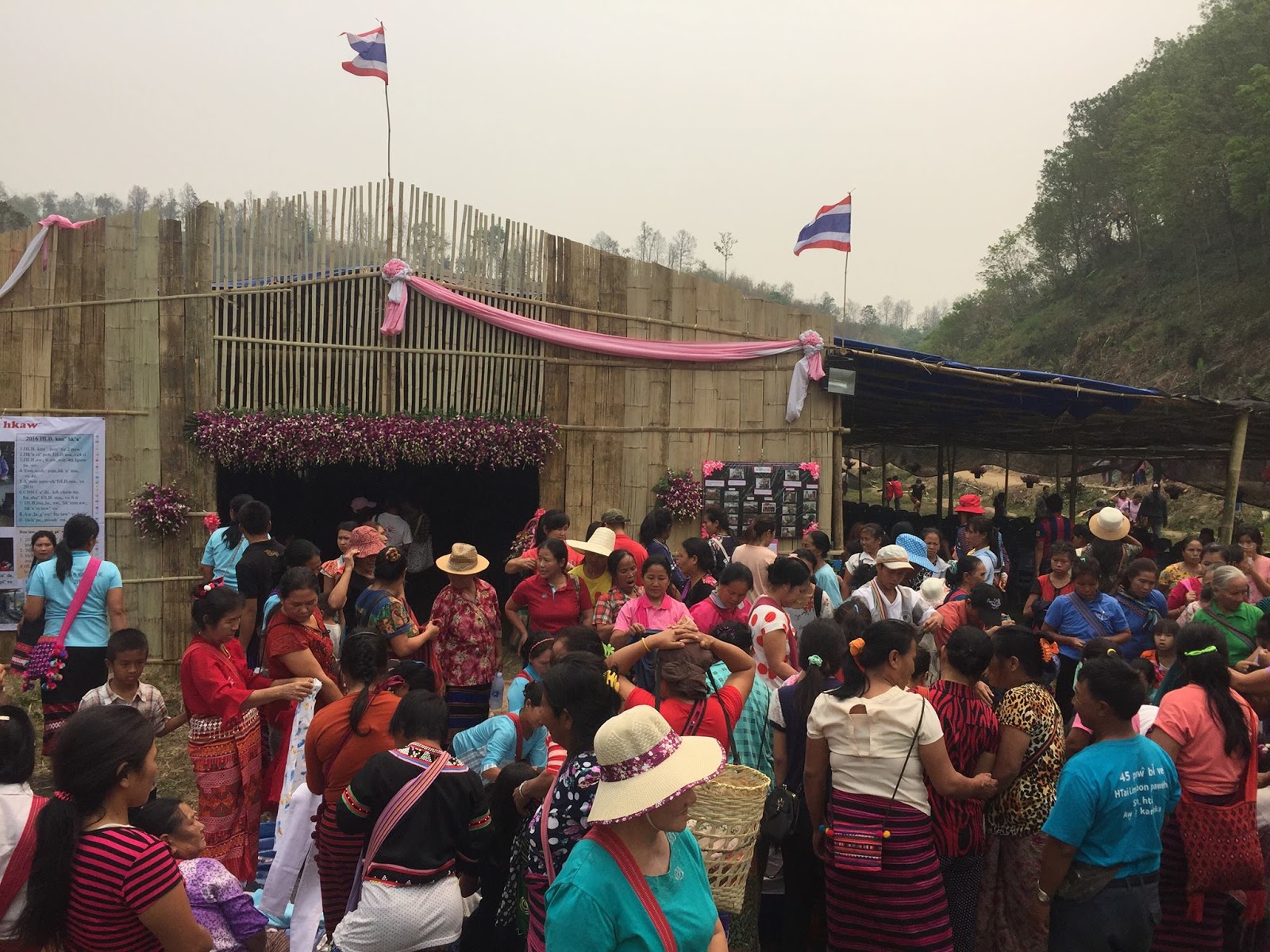
An estimated 8,000+ people from the Lahu hill tribe camped out and attended the 3 day event which concluded on Easter Day. Lahu tribes from China, Myanmar, and Laos were all present. Lahu is one of the largest hill tribe populations within Thailand with a number of subgroups within, all having unique languages and cultural customs respectively. An example being the largest Lahu subgroup, the Black Lahu, whose language is considered the core of all Lahu languages.

Originally, Lahus practiced a polytheistic religion and during the 17th century Buddhism became widespread within the hill tribe. Missionaries (many of whom began their work in Myanmar) later spread to northern Thailand, reaching the Lahu hill tribes. Today the impact of the missionary presence is evident as they developed a Romanized phonetic alphabet for the Lahu language in the early 19th century. I was humbled by my host family’s invitation and eagerness to allow me to attend and witness their event as an outsider.


On the second day of the Lahu Baptist Convention, women of the Lahu hilltribe gathered around a pile of donated clothes and distribute the offerings from their church.


Shehleh Lahu Convention


With two elders of the Shehleh Lahu tribe wearing traditional garments (to the right) and a local woman as we prepare lunch for hundreds of people.

Perhaps the most memorable moment of internship was partaking in the annual Shehleh Lahu hill tribe gathering with members from China and northern Thailand. The convention was a three-day event located in the Mae Hong Son Province (also home of the popular tourist destination, Pai).

My host dad and I were invited to attend the event and spend the night at the mayor’s home.


Throughout the day, I enjoyed learning how to prepare food fresh from the mountain because the act of community style cooking— with all hands on deck and massive cooking equipment— is a valued part of their daily life. Although it was difficult to verbally communicate since I cannot speak Lahu and many cannot speak English or Thai, I felt a human connection through warm smiles and body language.

In the evening, lively entertainment commenced with a mix of traditional customs such as dancing in a large circle, hand-in-hand with the person next to you, to the rhythm of traditional instruments. The convention also incorporated more modern festivities such as comedy skits and dance performances. My host dad and I stayed up late, enjoyed the performances, and chatted with the elders of the tribe while drinking tea from the mountain with flakey coconut crackers.


Rotary International
My host dad, Mr. Pramote, is a member of the Northern Thailand, Chiang Mai District Rotary International Organization. Alongside hosting me at his house, he also took in a Rotary Youth Exchange student from Mexico. I learned about Rotary International as I attended weekly meetings. I also had the opportunity to speak at a meeting about my experience teaching English in Thailand and interning with BFF.


Speaking about my experience teaching English in Thailand and interning with BFF
at a Rotary International meeting.


Final thoughts

In addition to interning with Borderless Friendship Foundation, my time in Chiang Mai was invaluable as I gained a Thai family and made Thai friends that allowed me to practice (and butcher) Thai. I learned more about the Thai language, culture, history, and politics than I could've expected and I fell in love with Chiang Mai as a city. I hope to take the lessons I’ve learned with Borderless Friendship Foundation and apply it to future cross-cultural work.


My lovely host mom teaching me to how to cook pad thai, a popular Thai dish in both Thailand and America, at our house in Chiang Mai.


My Rotary International brother, Atit (Thai nickname meaning the sun), to the left and my Thai host brother, Thak, to the right at my host brother's university prom. Thak completed his BA in English at Payup, a private university in Chiang Mai and hopes to start his own travel business and become a tour guide!