07 March, 2016

Communicating Without Words


Crystal Kumtong is a Thai-Taiwanese-Chinese-American from Los Angeles, California.She graduated from the University of California, Los Angeles (UCLA) with a B.A. in Psychology and minors in Applied Developmental Psychology and Education. Crystal is a 2015-2016 Fulbright-AMCHAM English Teaching Assistant in Lampang, northern Thailand. She teaches kindergarten, a special abilities class, and grades 4 through 9, and promotes English learning through songs and silly tongue twisters. Crystal is passionate about promoting access to high-quality education to all students and wishes to work in early childhood education policy and reform. Outside the classroom, Crystal enjoys biking around her province and stumbling upon beautiful Buddhist temples, eating                                                                                          delicious food, and sleeping.


Having grown up speaking Thai with my parents, I was still nervous to come to Thailand and live here for a year. In America, the only people I spoke Thai to were my parents, but even then, I would often switch to English. I was ashamed of my American- Thai accent and would never willingly speak Thai to non-family members. I was afraid I would be judged and struggle to communicate with my limited Thai vocabulary. Despite my fears, I was very excited to come to my parents’ country and do the thing I love most: working with students.


My family


The past two summers, I studied abroad in Taiwan and
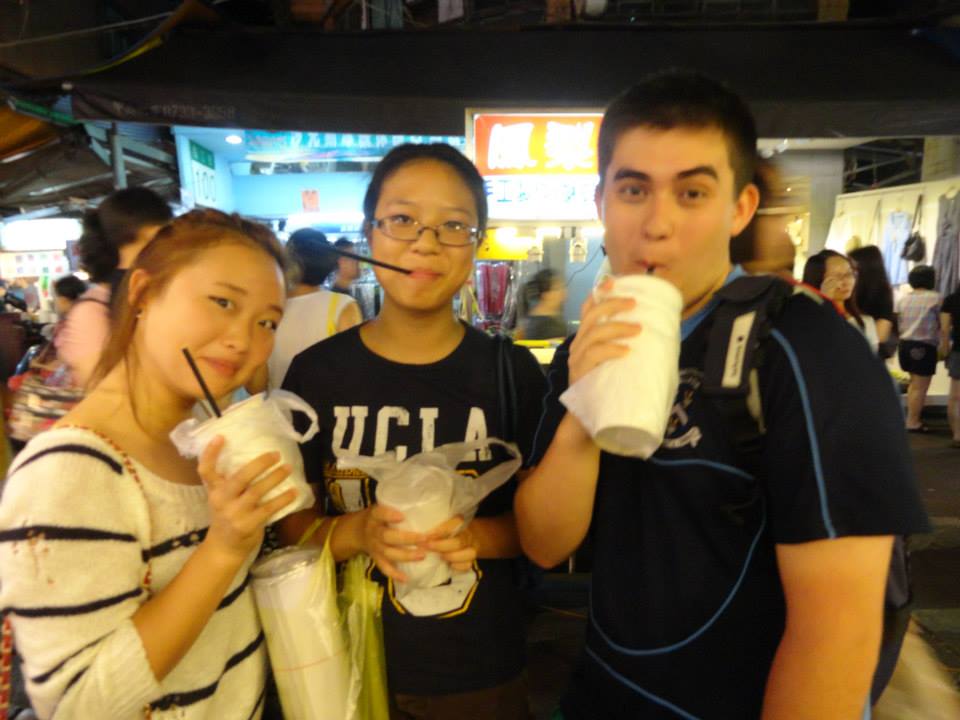
South Korea. I was in Taiwan for 2 ½ months to study Mandarin and I enjoyed the wonderful street food and milk tea boba. I learned how to (somewhat) haggle with street vendors 请可以便宜一点 (qǐng kěyǐ piányí yīdiǎn), and I nailed how to order a cup of milk tea boba with extra ice 一杯珍珠奶茶,多冰 (yībēi zhēnzhū nǎichá, duō bīng). I did not understand what was going on most of the time, but I was able to order my food and boba by pointing, gesturing, and using the limited Chinese I learned.


399284_10200294214413612_1010293073_n.jpg
Enjoying milk tea boba in Taiwan


In South Korea, the only phrase I knew was how to say “I’m an American.”, 저는미국사람이니다 (chul-nun migook sarang imnida). I said that phrase loudly and proudly, and as an explanation and apologies for my poor Korean language skills. I did not progress much beyond “hello” 안녕하세요 (annyeonghaseyo) and “thank you” 감사합니다 (ka sam nida). I struggled to speak Korean, but from my time in Taiwan, I knew that communicating was much more than speaking the language. I got around by gesturing, pointing, and trying really hard to get my point across through my body language and facial expressions, mainly of “please help this poor foreigner. I’m lost and confused”.


A temple in Korea


I knew that I wouldn’t have to struggle as much in Thailand, because I already knew the basics of Thai language. However, I was placed in Lampang in northern Thailand. In Lampang, people speak the northern language, or Lanna language ภาษาเหนือ/ภาษาเมือง (prasa nueu/ prasa mueng). Many words are similar, but it is a different language altogether. Classes are taught in “central” Thai, but it is not uncommon for teachers and students to speak and joke with each other in Lanna, the dialect they are most comfortable with.

Through my time abroad, I learned that communication encompasses more than just language. Yes, language is a huge part of being able to talk to someone and is a gateway to understanding new cultures, but there is more to it. Having been to three countries where I struggled to speak another language, I learned that the magic of communication happens when there are no words at all.

From my observations in Thailand, I learned that communication is …


A smile


Communication is when I visit the kind woman who sells tea and coffee in front of the school and she greets me with a genuine smile.

It is when the 2nd grade students sees me at the end of the hallway, yells out “TEACHER!” and tackles me down with a hug and then proceeds to carry my bag and pull me into their classroom.


Body language

It is when I am greeted every morning with a hug from the anuban (kindergarten) students, a high five from the prathom (elementary) school students, or sometimes even the middle finger. I do not know where these kids learned that from.

It is when a student shows you they are absolutely bored or displeased by your lesson when they sit with their arms crossed and eyebrows pinched together for the entire duration of you singing an English song. It’s a tough crowd.


Facial expressions

I teach a class of students with Special Abilities, and one of the students does not speak. At all. However, he is the most expressive and I do not have a hard time figuring out what he wants with just one expression.

He will touch my bag and look at me and I know he wants the stickers I periodically give out at the end of every lesson.

He will stand by my side, ready to pass out the papers or materials I have prepared for the class.

He does not always understand what the crazy lady in front of the class is gesturing and waving on about, but he will copy down everything I write on the board in his notebook. Everything.

One day, he showed me a live praying mantis and I nearly died inside. I asked him, “What are you doing with that praying mantis?” He smiled at me as his response. I told him to put the praying mantis down and let it back into the wild. Still smiling at me, he pocketed the creature inside his pant pocket and zipped it up. I somewhat hysterically exclaimed, “It’s going to die in there! Let it out!” He just smiled at me and let me know that the praying mantis was going to live in his pants for the rest of the class.


A kind gesture of gift giving

Being surprised with an orange here, a banana there, or a folded swan from a student. I have been so blessed with the kind thoughts and gestures from this community.


Sharing food


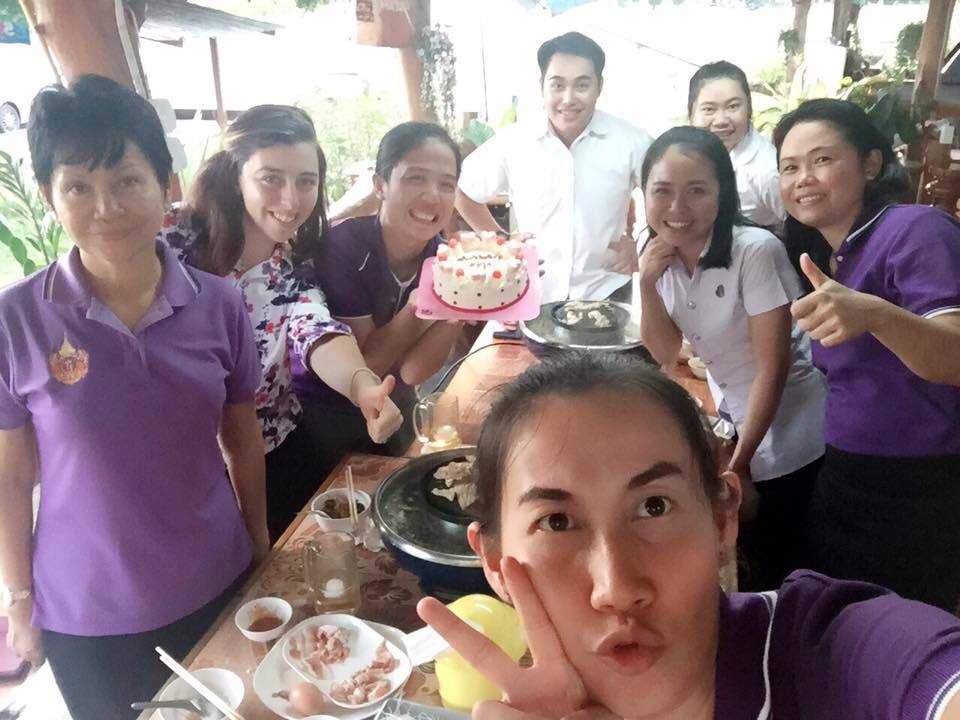
Every meal is shared family style and every lunch, the teachers sit together in the cafeteria. The teachers often bring extra food from home to share with each other. There is one teacher I do not really talk to, and she does not really talk to me. However, every time I sit down for lunch, she will hand me the plate of shared food to make sure I get some. She does not say anything or even look at me; she just hands me the plate and continues eating.

I know that there is no pressure to act, to speak, or to do anything with her. She simply acknowledges I am there, makes sure I am fed and then we go about our own lives. I am grateful for these quiet interactions where I am allowed to just be me.


Sharing time

The best gift anyone can give is time. It is those evenings where my neighbor(s) and I cook dinner and eat with other in front of the TV, speaking in a mix of Thai, Lanna, English, and Chinese.


Sharing food in Thailand with my Thai neighbors and Chinese teachers


It is when my ETA friend came to visit me and we just sat in comfortable silence, happy in knowing that we are there for each other.


Laughing

Laughing with the students, teachers, and friends. Laughing at the way you mispronounced a Thai word in front of the whole class, but it’s okay because both the teacher and students are learning.


Teaching the 2nd grade students how to play the cup song from the movie Pitch Perfect.


I was nervous to come to Thailand, but now I know that I do not have anything to worry about. People are kind and there are more ways to communicate with someone than just language. If you are willing to make the effort to go out of your comfort zone, you will find that communicating with someone who speaks a different language and has a different culture than you will be no problem at all. In the end, we are more similar with someone else than we are different.


01 March, 2016

Cultural Understanding: Verbal and Non-verbal


Dung Nguyen (aka Nu Dee) is from Atlanta, Georgia. Her Alma Mater is Wake Forest University where she earned a BA in Politics and International Affairs and a minor in Sociology. Dung Nguyen is a 2015-2016 Fulbright-AMCHAM ETA in Ubon Ratchathani province in northeastern Isaan Thailand. In her free time, Dung likes to explore hipster coffee shops in Ubon, looking for delicious coffee beans and pastries. After her Fulbright fellowship, Dung plans to explore more of Southeast Asia. Once she gets back to the U.S., she will pursue a Master’s degree in public policy.


Teachaa, Teachaa, Poot Pasa Thai!” (Teacher, Teacher, Speak Thai!)

My Thai 7th graders screamed, “Teachaa, Teachaa, poot pasa Thai!” from behind the classroom as I tried to explain an activity in English. Sitting on their wooden chairs and edging their bodies against the wooden desks toward me, my 7th graders expressed in unison with a rather confused look on their faces, “Mai kao jai Teachaaa” (I don’t understand, teacher). As flustered as they were, I tried to use body movements, hand gestures, and repetition of simple verbs to show them what I wanted them to do. After a few demonstrations, they finally understood the tasks assigned to them, which was to write 5 sentences using the vocabulary that they have learned and then act it out with their partner. This was my first week on the job as a Fulbright English Teacher Assistant (ETA), and it was the first time in which I felt inadequate and overwhelmed as an ETA. “How can I teach my students if I don’t speak their native language?,” I thought to myself. But with time and knowing the personalities of my classes, “Teachaa, Teachaa, poot pasa  Thai!” and “Mai kao jai Teachaa” became two of my favorite Thai phrases. Instead of internalizing these Thai phrases as an indication of my bad lessons or teaching abilities, I now use these occurrences of “Mai kao jai” as opportunities for both my students and me to have moments of cultural exchange and understanding.


Dung is teaching her 7th graders about holidays in November--Thanksgiving,
which is celebrated in the United States and Loy Kratong, which is celebrated in Thailand.


I notice that sometimes students say “Teachaa, Teachaa, poot pasa Thai!” and “Mai kao jai Teachaaa” because the content is overwhelming. To simplify the instructions and bridge our language differences, I tell my students, “I teach you one word, and you teach me one.” It’s only fair that I go through the same struggles that they do when it comes to acquiring a new language. So, with each lesson that I teach my students, they would say the vocabulary words in Thai and then repeat it again in English. There are definitely moments of laughter as I mispronounce words and make a fool of myself. For instance, I said two Isaan words, “Bak Nat. Bak Si Da” (pineapple and guava) during a fruit lesson and my students got super excited and interested as they screamed “Ohhhhh Teachhaaaa dee mahk!! (Teacher, good job!)”. Because I was being silly and showed an interest in learning about their culture and language, it made my students comfortable and interested in the lesson as well. In this process of language exchange, it motivates and encourages my students to speak English and not be afraid of making mistakes. Now, “Mai kao jai, Teachaaa” becomes 

Dung is pictured being goofy with her 12th graders. 
“Teachaa, again please?” because they want me to repeat the instructions or vocabulary words. Or perhaps, they just want to see how ridiculous I am as I repeat the words both in English and Thai and act it out. But regardless of their true intentions, I made them interested and that was a victory for me. So, sure, I’ll speak Thai and Isaan. But, I always say with a smile, “Okay, now it is your turn. Speak English students (Phoot brasa ung-grit nak rearian)!” 


Beyond the Classroom 

Other triumphant moments that I have with my students are when students go to my office hours or invite me to coffee shops to practice their English. 
They would say with a smile yet confused look on their faces, “Mai kao jai, Teachaaa. Explain please.” when we stumble upon phrases that they don’t understand. For example, one of my 12th graders, Preaw would come to my office hours and invite me to coffee
Dung is tutoring one of her students during office hours. 
shops to talk about similarities and differences between Thai and American culture, our family, our thoughts about Ubon Ratchathani, future plans, and etc. In between stories, we would laugh at awkward English phrases that she says or my Thai mispronunciations. Through these interactions and relationships that I have developed my students, they now no longer have faces of confusion but faces of curiosity. I show them that learning English does not only give them an edge and advantage in this global world, but it also allows them to create these meaningful relationships with others who are different from them.


Talking Bodies

It’s these human interactions and relationships that I have developed with my students over time that exemplify the power of attitude and a smile. Knowing English in our globalized world is an important asset, but smiling is also very advantageous. A smile is welcoming, inviting, and warm, and it is here in Thailand that I’ve seen the most smiles. Thailand, known as the land of smiles, rings true to its reputation. I notice that my students say “Phoot brasa Thai, Teachaaa” with a smile. They say, “Mai kao jai, Teachaaa” with a smile. To break the barrier between my students and me, I also use my smile in and outside the classroom to show them that I am not some scary, foreign creature. I teach with a smile and greet them in the morning with a smile. I show them that my smile is like theirs. My laughter is like theirs. Although we might not speak the same language, we both have bodies that do speak the same language. 


A Smile is A Smile
What’s in a smile? But specifically, what’s in a Thai smile? The simple and short answer to this question is that a Thai smile could mean many things, but it could also mean nothing. I now know that a Thai smile could mean ‘Yes teacher, I understand the lesson’ or ‘no teacher, I do not understand the lesson’ or ‘I am bored out of my mind, but I will smile to keep you happy’. 

Dung went camping with her 8th graders,
hiking on a trail together.
A Thai smile could mean nothing in the sense that my students are genuinely happy that particular day and want to smile to portray their jolly vibe. I used to think that Thai smiles are confusing and difficult to decipher, but when I pay attention to the creases of their eyes as my students smile and their body postures, it is not hard decode their true meanings. A smile is a smile, and it reveals all types of messages!


Fusion of Body and Spoken Language

My Fulbright ETA experience has taught me many things about myself and Thailand. But, one of the most important lessons I’ve learned is the power of a smile—the power of merging spoken language and body language into communication. Our body language, specifically, our smiles speaks to one another, telling each other that it’s okay to be silly and laugh. It acts as a comforter, supporter and catalysts for human interactions. Our smiles and facial expressions sometimes do not require spoken words to tell one another how we feel or think. The fusion of body and spoken language in communication is powerful when closely examined! So readers, when you travel to a country with a limited knowledge of their language, smile and embrace the adventures and awakenings that awaits you!


24 February, 2016

A Year in a Thai Classroom


Daniel Chen was born and raised in Brooklyn, New York. His Alma Mater is American University in Washington, D.C. where he received a B.A. degree in International Studies with a focus on US-East Asia relations. Daniel is a 2015- 2016 Fulbright-AMCHAM English Teaching Assistant at Triam Udom Suksa School of the North in Phitsanulok Province, Thailand. Daniel loves exploring the province and traveling to other parts of Thailand. He always tries to engage in as many cultural Thai experiences as possible. In the future, Daniel hopes to work in the field of international diplomacy either within an American Embassy or through the private sector.


WHY THAILAND?

My first trip to Thailand was in the summer of 2014. I was going through a difficult time in my life and I felt that I needed to be somewhere completely different, so I headed on a two month-long volunteer, teaching trip to rural Phichit, Thailand. Being a teacher was incredibly challenging both inside and outside of the classroom. I taught first grade all the way up to ninth grade. Each class had varying dynamics and learning styles, which required constant attention. Each day, I had to quickly change my teaching style to accommodate each class. And after exhausting myself in my classes, I had to create lesson plans for the following day. Luckily, I lived with a homestay who never ceased to make me smile. They immediately treated me like a family member who got amnesia and forgot how to speak Thai. Although I initially approached the country with no expectations, I can safely say that it was the fastest internal growth that I have ever had in my life. This narrative reflection is solely from my personal experience. These disadvantages have also been exacerbated my lack of Thai proficiency.


My Thai family

I have never been to a place with a culture as frustratingly and beautifully complicated, with people as warm and helpful, and with food as spicy as Thailand. Thailand instilled in me a newfound love for my fellow man as well as optimism in my own ability to help others. After returning to America for my last semester in university, I set two prioritys: the first was to teach and the second was to be in Thailand. My acceptance into the Fulbright ETA program was one of the happiest days in 2015. I felt like I was going back home.


Phitsanulok


Based on my past experiences, Fulbright placed in Phitsanulok. Phitsanulok is not a popular tourist destination, but the city is lively and filled with history. The supposedly most beautiful depiction of the Buddha is in the center of the city at Wat Yai. It attracts a constant stream of tourist coming for a rest stop as they are traveling from Bangkok to Chiang Mai.


Wat Yai Temple


Many locals I have talked to consider Phitsanulok a typical, traditional Thai city. Nearly all people here are devout Buddhists who hold immense love and respect for the king. The society has a stiff hierarchy that manifests into a variety of formal interactions with two people from different places in society. Older Thais are particularly quick on correcting nuances in your communication, including from how you wai (introductory bow) to how you structure your sentences. This is prevalent in many levels of formal society, especially in schools. However, the new generation of young adults are much more modern. Their tastes are materialized in the city’s countless hip cafes, chic restaurants, live music bars, and scandalous fashion of those indulging in the Phitsanulok nightlife. These generational differences make Phitsanulok a diverse and interesting city.


Teaching

I love teaching in Thailand. The majority of Thai students immediately treated me with respect and seemed genuinely excited to learn English. The students were forgiving while I was testing out teaching techniques and gauging their proficiency levels. They tend to be shy, so it has been a fun challenge to making them more comfortable with English and speaking with me on a more personal level.

One of my favorite and least favorite aspects about my specific school is the lack of curriculum guidelines. I can basically teach anything I want that relates remotely to conversational English. This gives me an almost nerve-racking amount of freedom to decide what is important and not important for my students to learn. I started off with teaching basics, such as emotions, asking for the time, asking for directions, etc. However, the initial excitement I garnered started to taper off. I started to feel self-conscious about my teaching and questioning everything about my ability to help my students.

My students are all in 11th or 12th grade, so they are 16 to 19 years old. Like any older teenager, my students have low attention spans. Therefore, the first impression at the beginning of each class is critical. If I peak their interest at the beginning, the class runs much more smoothly because the students are more inclined to listened. The opposite is true with a disorganized beginning where students subconsciously decide that the class is irrelevant and start to look for other ways to entertain themselves, such as their cellphones. The lack of engagement is stressful, so I have to constantly remind myself that I would probably considered a bad student when I was in high school. I have this realization every time I get angry with any of my students, which is several times a week.

Halfway through the semester, I changed my lessons from individual lessons to a unit lesson. I decided to start teaching something that every high school student is interested in, dating. Suddenly, I had classes where basically every student was engaged and actively trying to participate in the lessons. Here is a sample of the dialogue I used for asking out strangers:


A: "Hi. My name is (Daniel). You have (beautiful eyes). What is your name?"

B: "Thank you. My name is (Fah)."
A: "Would you like to (go to the movies) with me?"


When I asked for volunteers to demonstrate the dialogue, the entire class would yell names of students who were widely believed to like each other. Of course, I picked whomever they yelled to present. There were very cute and some very inappropriate compliments from the students. I ended my dating unit with break ups. Here is a sample:


A: "I think we should break up. I don’t want to see you anymore."
B: "No! I don’t want to break up. I love you."
A: "I want to break up because (you don’t spend time with me)."
B: "I can change. (I will make more time for you)."


The break-up performances were even more outrageous. Some gave Oscar worthy performances, crawling on the floor and on the verge of tears, begging to not break up. People were gasping, laughing, crying, and screaming. Some even in English! Students asked me about my own dating life and they were more than happy to share theirs. Certain classes were the some of the best minutes of my professional life.

Nevertheless, there are a number of disadvantages of my role as a foreign teacher.


1. Surprise holidays and cancelled classes

On multiple occasions, school was cancelled and I would only be told one or two days before. One time, an entire week of class was cancelled because of a gigantic music competition being held at my school. I didn’t see two of my classes until the second month of the semester because Friday classes were cancelled consecutively for weeks.


2. Missing students and grades

The semester ends in three weeks and I have not seen several of my students. They never come to class and I have not been given the opportunity to ask why because they never come. Sometimes, I see students outside during the time that they are suppose to be in my class. When I asked why they are not coming to class, they make an excuse in Thai and hurry off. Students are constantly coming to class late. At the beginning, I would ask why and they always had excuses. My Thai is not proficient enough to confirm if it is true or not. Moreover, my school has an incredible number of events and extracurriculars, so any student can have a legitimate excuse at any time. But, some students are obviously taking advantage of the fact that I am a foreign teacher who has not very limited ability to tell them to come to class.

Because my class is primarily for conversation, I made conversation half of their grade. Based on this rubric, a significant percentage of my students would fail solely because of absences. However, the goal of my class is to empower my students to speak English. Failing them can only do the exact opposite.


I LOVE THAILAND!

Regardless of the daily frustrations, my love for Thailand has not changed. Like my previous Thai experience, I have meet incredibly kind-hearted people and have learned to appreciate Thai culture more everyday. One of my co-teachers, P’ Mao, embodies every positive quality that I could hope to find in another human being. She brings me breakfast and lunch almost on a daily basis. If I show any sign of distress, P’ Mao races to ask me if I am okay and if she can do anything to help me. I feel like I could tell her anything and ask for help on any type of issue. P’ Mao has become a mother to me more than anything else. 


Even the disadvantages I mentioned have a redeeming quality. Because of the extra holidays, I have extra time to travel through the diverse landscapes in Thailand. I have been on numerous weekend trips and witnessed something breathtakingly beautiful. On the week off, I went scuba diving in the premier diving location in Thailand, Koh Tao. With the missing students, my class sizes are much smaller and easier to manage. The students who actually want to learn come on a regular basis. My small classes are always more engaging, we cover more material, and it is less stressful for everyone. Some of my favorite classes have been with half of my class missing.

I never thought I would be as comfortable as quickly in a country as different from America as Thailand. Needless to say, coming to Thailand has been one of the best decisions of my life.


Thailand's Phukradueng in Loei Province
Koh Tao Island

16 February, 2016

From Birthplace to Home


Ia Vang is from Minneapolis, Minnesota. She graduated from Carleton College with a Bachelor of Arts degree in American Studies and a concentration in Educational Studies. Ia is a 2015-2016 Fulbright-AMCHAM English Teaching Assistant in Thakhonyang Pittayakom School in Mahasarakham, Thailand. When Ia is not teaching, she enjoys watching movies, going to cultural events, and capturing photos of food. After Fulbright, she plans to gain further work experiences in the education field before attending graduate school.


Before arriving here, my parents praised enthusiastically about Thailand. Both of my parents were born in Laos but grew up in Thailand. They both can speak Thai and love Thai food. My mother would sometimes say that when she gets old, she would like to return to Thailand to live there.

I never really understood my parents’ love and admiration for Thailand because, even though I was born in Thailand, I was raised as a Hmong-American in Minnesota. I grew up with stories about my parents’ experiences in Thailand. Whenever they spoke of their experiences, Thailand was a place where they sounded very happy and free. Thailand was home for them at a time of war and it had occupied a space in their heart.

It’s been a little bit over than four months that I’ve been here and I have slowly come to realize why my parents admired and respect Thailand deeply. There are three things that I have come to admire about Thailand thus far, and maybe these aspects of the Thai culture are some of the reasons why my parents love Thailand so much.

1. Thai language. As difficult as it is, I have continuously written down new Thai vocabulary here and there. On my birthday, one of the student teachers in the school I’m teaching, Thakhonyang Pittayakom, gave me an alphabet workbook to practice writing the Thai alphabet. The reason why I practice and learn Thai is because there are words that the Hmong language has adopted from the Thai language. Here are some examples:

- Candy = kanom

- Lime = ma-naow

- Red curry noodle dish = kao poon

- Bathroom = hong nam

- Pair = kuu

- Family = krop kruo

- Minute = nah- tee

- Coconut = ma -prow

- Mango = ma -moung

- Socks = toong-tahw


Every time I hear familiar words like these, I am always in awe. It makes me interested in what other aspects the Hmong have learned and adopted from the Thais.

The Hmong language doesn’t have its own written alphabet. It has adopted the English alphabet and that is what people used to read and write in Hmong.

My father in particularly admires the Thai language. The Thai language was his second language, whereas for my siblings and I, English was our second language. Although they are different languages, I believe we shared similar struggles in learning them. For my father acquiring the skills to speak, read, and write in Thai was something he was very proud of. I witness this moment when we came to visit Thailand for the first time in 2007 and he would speak with locals in Thai. For my parents, the ability to speak Thai gave them opportunities to communicate with different kind of people. I think they really cherished those connections they have made with others by learning how to communicate in Thai.

2. Thai Food. I grew up eating white and purple sticky rice, papaya salad, curry noodles, and laarb. When I arrived in Thailand, these dishes weren’t strange to me. I was very excited to try these authentic Thai dishes and learn their Thai names. Thai food is also eaten in family-style. Therefore, there’s a lot of sharing when it comes to food. I’ve learned during my time here that Thai food is amazing, but it’s even more amazing if you shared it with others.

This is a small list of observations I have made on family-style meals in Thailand thus far:

1. There are various dishes in the middle of the table for everyone to share.

2. Rice is the main dish. This includes sticky rice and/or white rice. However, I did have a meal where it is all papaya salad (som tum) and fried chicken, so we had rice noodles (kanom gin) as the main dish.

3. Sometimes the dishes come with a serving spoon.

4. Everyone eats with a fork and a spoon. Sometimes the fork is to scoop the portion of food onto the spoon.

Thai family-style eating is very similar to what I grew up with. Growing up, my father had always emphasized how dinner is family time. It’s a time to have conversations and relax with one another. I see this a lot when I am with the student teachers at my school. We would eat lunch together all the time and even though sometimes I don’t understand what they are talking about, is great to share a meal together.

Food is also used as gifts. I remember asking one of the student teachers at my school what kind of gifts I should give to my students who performed with me on Christmas day. She said, “Buy them kanom (candy) or any type of food. They would appreciate it more than something material like a toy.” I bought them candy canes, and they were super happy because they never seen them before.

I also received an abundance of food gifts since I’ve been living in Mahasarakham province. The owner of the apartment building I live in, who I call uncle, has given me fruits as gifts a couple of times. In return, I always buy kanom or some fruits on my way back home from school to give to him.


Bananas that uncle, the owner of the apartment building I lived in, gave to me.


Every morning when I go to school, I always get asked the question, “Ajahn Ia, kin khao reu yang? (Teacher Ia, did you eat breakfast yet?)” Even though I said I already ate (kin laew), a few of the teachers in Thakhonyang Pittayakom School would give me something to eat. For instance, I received a kao jee (sticky rice covered with egg) and grilled pork on a stick from a teacher.


Breakfast gift (kao jee and grilled pork on a stick) from a teacher


On Christmas, the director from my school gave me a basket full of goodies. Because of these experiences, I also have acquired this custom by giving food as gifts back to teachers, my p’s (a polite prefix used to address someone older), students and anyone who I want to show appreciation and respect to.


Christmas gift from the director of Thakhonyang School


Sharing food with others reminded me of an old saying my mother used to tell my siblings and I when we were going through poverty the first few years in America. She said, “This (She was referring to the food we are eating) may not be the most delicious but if you eat it with others, it becomes delicious.” She is right. I am not saying that Thai food isn’t delicious and that you need people to make it delicious. What I’m saying is that there is something unique about sharing food with others. For me, I interpret the act of sharing food as sharing a moment of joy with one another. Food helps people to connect and learned from one another. Sharing food not only creates connections but also creates opportunities for cultural exchange and appreciation.

3. Care and Kindness
. I cannot generalize that all people in Thailand are kind, but I can tell you that the people I am surrounded with every day in Mahasarakham are kind. The people I have met here and spend the most time with are some of the most generous people I have ever met. For example, it was getting late during a dance rehearsal I had with some of my students and they told me to go home. I asked them why. They said I should go home before dark because I bike to school, and they wanted me to be safe. It’s little moments like this that makes me wonder about my parents’ stories of Thailand. Did they feel this similar emotion? Do they share similar experiences with the acts of kindness and generosity that I am experiencing?

These three things are what I have come to love about Thailand. Although I am not sure if it is the same for my parents, I can tell you that it is possible. These aspects of Thai culture are what I grew up with. Papaya salad (som tum), laarb, and sticky rice are dishes my mother has cooked for my siblings and I since we were kids. My father uses Thai phrases to speak with us sometimes. For instance, my father would say kin khao (literal transition: Eat rice, but it means eating in general).


Sharing papaya salad with toppings with the student teachers


Living in Thailand has made me realized the “Thainess” I have grown up with. My parents acquired these aspects for reasons. Even after years of not having anyone to really speak Thai with, my parents can still speak it quite fluently. Even after the 21 years we have lived in America, my mother still cook us some Thai dishes.

Thailand used to just be my birthplace. A country I didn’t really know about. I used to not understand why my parents admire Thailand so much. I may never really know until I go back home and have a long conversation with them about it, but I do know one thing. Now Thailand is slowly becoming a third home to me.

I’m starting to see how beautifully the Thai culture is woven into the Hmong culture. Because of this, I have become more appreciative of the different cultures in my life, as I continue to learn more about the Thai culture each day. By learning about the Thai culture, I learn a bit more about the Hmong and America culture, and together, I come to slowly realize who I am as a person. 


08 February, 2016

At your Home or Across the Sea Home is Home


Elaine Flores is from Calexico, California. Her Alma Mater is San Diego State University (SDSU) where she received a degree in English and a minor in Spanish. Elaine is a 2015- 2016 Fulbright-AMCHAM English Teaching Assistant at Sawananan Wittaya School in Sawankhalok, Sukhothai, a province in central Thailand. When she is not teaching, she tutors students after school, attempts learning as much Thai as possible, and travels around Thailand with her Thai family.  Post Fulbright, Elaine plans on dedicating her time to teaching,pursuing a Masters, and becoming an administrator in the field of education.


When one travels, one looks for similarities and familiarities to comfort themselves and properly adjust to a new atmosphere. Maybe it’s just me, but I think it’s a subconscious act our brain does to say, ‘Hey that looks like that one thing from that one place!’ It’s natural. For me, my first steps into Thailand were of course a shock. Especially it being the first country I’ve visited abroad. Regardless of the shock, I’ve found one too many similarities between Mexico and Thailand that helped me feel comfortable and at home. “Wait I thought you said you haven’t been abroad?” ­I consider abroad going past North America: Central, South America, Asia, South East Asia, Europe etc. Also when I say Mexico I think more culturally, and more so the northern border of Mexico that touches California: Mexicali. No I cannot say I’ve been deep into Mexico nor that I know all about my Mexican roots, but I can definitely point out a lot of similarities between two places and situations I’ve been in; Thai and Mexican cultures. Many P’s ­host teachers or elders­ have tried to explain different aspects of the Thai culture and sometimes they look at me with a, ‘Why isn’t this a shock for you’ face. Many times I reply with, “Oh, yes in Mexico...” or “Back at home…”(Calexico, predominantly a Mexican­American border town in California). Therefore a lot of the “shocking” aspects of Thai culture aren’t as foreign as I thought they’d be before I flew over in September. So here is my list so far of the many similarities I can find between the Thai and Mexican culture: 

Television:​ The first time my P’s turned on the T.V. in the office I thought I was over hearing a Mexican broadcasting, when I looked up it was as if all the Mexicans turned Thai, but were doing the same things. In short: when it is a game show there is extra ridiculous outfits, people fall, there may be some play fighting, and every movement has a *Bing! *Boing! *Booom! or random Tuba sound. As for soap operas, the most melodramatic T.V. I’ve ever seen: Mexican “Novelas.” Well apparently Thai television has the same melodramatic script! 

Language: ​In English­ “The red car.” In Spanish: “El carro rojo.” In Thai: “Lot see dang.” (car, red). I’ve heard many complain that Spanish is ‘backwards;’ well so is Thai and I’m curious if it’s English that is ‘backwards’ now. 

Lemon/ Lime/ Manao: ​In Mexico Lemon is the ultimate garnishing. People love their lemon/ lime. I have found that true in Thailand too. There is a lemon on every dish to help you get your right flavor. 

Sugar: ​Growing up Mexican­Am. I know that Mexican’s typically have a sweet tooth. ‘Un panecito para el café,' a little sweet bread for the coffee. Or a fruit with chili drink, or ice cream, or flan, or more sweet bread. There are Mexican desserts 24/7. Same with Thailand, there are so many dessert shops it is unbelievable. I've had so many and yet I still find something new to try. 


Pistachio Mocha cake found at Vista Café


Spice: ​In Mexico there is no question whether you want your food spicy or less spicy. Salsa is on the table, the green one more mild the the red one, but be careful they may surprise you and be switched! In Thailand: ‘Phet Mai?’ (Do you want it spicy?) is a question you will get at every restaurant all the time. To their surprise I say ‘Phet mak mak!’ (Super spicy please!) I may sometimes sweat, but spice is a flavor I crave now. 

Family:​ Always time for family. I find that family sticks together in Mexican culture more than in American culture. So many of my friends stayed home and to my surprise it’s because they wanted to and liked being home and with family. I was a little more Americanized in this regard. Again, in Thailand staying close to family isn’t even a question. You do it because family is life. Also the level of respect of the elders of both cultures families go above and beyond. 

Community: ​It takes a village to raise a child. Everyone knows everyone in the smaller towns and if your doing good or bad, it will be talked about. Why? Because they care a lot about the community and its members. 

Any time is party time: ​In Thailand school can be shut down for any reason, sports day, Christmas, random outing for the school, a battle of the bands. Although I went to school in America, I had some friends who went to school in Mexico and would tell me how they were released early or didn't have school because of: teacher's day, students day, Thanksgiving (No this is not an official Mexican Holiday!) 

Time: ​Is liquid. In Mexico 5pm is 6­6:30pm. In Thai 5pm is an hour earlier or later. Sabai Sabai. 

Karaoke:​ If there is a party the karaoke is coming out for hours in both Thailand and Mexico. 

A belief system:​ In Thailand there are temples everywhere. It is there history and it is what their way of life is built around. Same with Mexico. Although times are changing, Christianity/ Catholicism is deeply rooted in the Mexican culture and one can find old churches anywhere. 

Friendly/ Hospitable:​ ‘Mi casa su casa’­ same in Thailand. Almost all of the teachers I have met have offered to take me somewhere, fed me, or told me I could go to them for anything. 

Small outdoor vendors:​ It doesn’t take much to sell on the street in either country like America. If your mango tree has a surplus of mangos and you want to sell them go ahead. There won’t be any licence or permit check. 

Traffic/ Intense driving:​ Getting on the road is your own risk in both countries. 

Homeless dogs:​ are everywhere 

No toilet paper in the toilets: ​their sewage can’t handle it. Don’t do it. 

Soccer Futbol Football: ​Their number one sport. The first question my students asked was “What is your favorite Football team?” ­”Umm Chargers?” 

Tamarind/ Tamarindo or fresh fruit everywhere:​ Tamarind is a very common ingredient in a lot of Mexican candy. In Thailand it too is a common flavor. My fellow ETA had never tasted Tamarind before, I had been introduced to it when I was 5. To add to that fresh fruit is accessible anywhere you go in both countries because the weather allows all the wonderful fruit to grow. 


Fresh fruit sold by vendors at Chatuchak Market


Veggies:​ are either for garnishing or for flavor 

Vicks/ Menthol: “Ponte el vicks!” If you feel nauseous, smell Vicks, if you have a runny nose, apply Vicks under your nose, if you have a cold, apply Vicks on your back and chest. To my surprise Thailand has their version of Vicks. It’s a tube and non applicable, but you can smell the aroma and it cures: vertigo, allergies, runny nose, headaches. It has the same main ingredient Menthol but that was the icing on the cake. I thought to myself, “Wow I really know how to choose home!” 


Thailand's version of Vicks!


It’s been nice to have so much familiarity in a new place, it makes it easier to call Thailand my home. It also has taught me what seemed so spectacular on the other side of the world is actually very close to home.


01 February, 2016

My School Family


Ariel Stenger is a Kentucky native and earned a BS in Economics and Asian Studies from the University of Louisville. Ariel is a 2015-2016 Fulbright-AMCHAM ETA in Chaing Rai province in northern Thailand. She brings two years of teaching experience from Teach For America in the Pine Ridge Reservation of South Dakota. Ariel's home in rural Chiang Rai allows her to connect with students and their families outside the classroom at community events like weddings, merit-making and weekly markets. After Ariel's exchange program, she will continue working for cross cultural understanding while promoting gender equality.


Neung, song, sam, see, ha, hok, jet, bet, gao, sip.


Who knew that counting from one to ten could be so critical to sports day? Imagine over 500 students organized in six color teams, packed in bleachers, on the peripheral of a grassy soccer field nested at the base of Chiang Rai’s mountains. Each student sported their team shirt color, the same style of gym pants and fixated their eyes on the lead student, orchestrating the cheer sequence with a nonverbal head nod between the student drummer, in the front. The blue team of 60 students from 12-18 years old chorused collective cheers while doing synchronized hand movements. This was sports day.


Each group is led by students who create cheers and hand movements within a theme for their color team. This year, themes ranged from Pikachu, to witches and traditional northern-Thai. Each color team organized a parade dance as well. Students nominated their princess, dedicated their lady boys in special attire and created a moving show to demonstrate their creativity and color pride as they competed for sports day awards.


The blue team sitting in solidarity preparing for their cheerleaders.


I was catapulted into this energetic, organized and fun day on my second day in Mae Lao, a small village of about 3,000 people in northern Thailand. I walked around with my host teacher and mentor, visiting students who shared a variety of fun facts like, "I love you!" and, "I can't speak English."


Joining the student parade, the drumline and cheerleader princess show respect for Thailand and excitement.


My intrigue for learning about Thai culture encompassed my social life, as well. My housemate and colleague, P'Pui, eagerly welcomed me to our new home. She showed me how to use the two-tub washing machine, offered me house shoes and invited me to join nightly dinners with other teachers. Two months later, I enjoy daily meals, spicy som tum (green papaya salad) and inside jokes with my new friends as we sing karaoke, plan classes and laugh as we use snap chat filters together.


Taking a selfie with a fellow teacher and supporting the Pikachu team.


One night after dinner near the famous 7-11, we saw the varsity soccer students soaking in every minute of sunlight for practice. The sun was setting and the field doesn’t have lights so P'Pui and three other teachers greeted the students. It was quite late and the sun had set, so the teachers kindly told the boys to wrap up their game and head home. Each teacher expressed their concern for the boys’ safety. Though the boys were disappointed to finish playing their beloved soccer, each player respectfully wai-ed** each of us before hopping on their motorbikes and going home. This made me realize that teachers hold a special place in Thai schools.


Teacher dinners include everyone in the department, from the student teachers to the department directors.

As a teacher, I am not limited to teaching in the classroom. In fact, I am encouraged to join soccer practice, lead club activities, support other teacher projects, mentor students applying to university, volunteer at a local orphanage and share music with students after school. The role of ‘teacher’ is akin to an aunt in American culture. This generates a familial environment of support, interconnectedness and healthy honesty to understand important boundaries.

Some people say it takes a village to raise a child, but in my case, I am witnessing an entire school community work as a village. Mae Lao Wittayakom functions as a never-ending circle of mentors and mentees, both within the teachers and students.

Teachers and students look out for each other. Students offer to carry materials for the teachers regularly in exchange for encouragement, while even the slightest eyebrow raise will galvanize a student to hastily tuck in a shirt tail. Experienced teachers dote on younger teachers, mentoring and mothering them during morning assembly and lunch. When one person wins the lottery in the school office, everyone wins.


The interconnectedness at LMK includes the non-humans, too. Our school dog, Lung, has only one eye. About 10 years ago, some students found a little puppy in very poor health. They started a campaign and had fundraised among the student body to save the little puppy. Every day since, Lung has been the ‘school dog’. There's not a day that goes by when I don't see a student buying a hotdog to give to Lung, ensuring he's fed. I wasn’t surprised that everyone banded together again to cover the medical costs when he was regrettably hit by a car. With the collective prayers, extra hot dog treats and a visit to the veterinarian, Lung has recovered and is back in the business of joining English class.


At a teacher and student dinner, our school dog Lung waits patiently for the hot pot leftover.


Whether it’s sports day, a random night after school, or in a challenging time, the sense of collective community and compassion for each other at MLK is heart-warming. To be welcomed into the Mae Lao family has been wholesome. Though I wondered how I might fit into the school family at first, I have consistently been included. With my host teachers, I have been the mentee, English mentor, niece, daughter and friend. With my students, I have been the teacher, mentor, older sister, karaoke partner, soccer practice player, and liaison to American culture. With Lung, I have been the hot dog treat giver and American English slang teacher. Our school family is welcoming, supportive and unassuming and I wouldn’t want to be anywhere else. 


Sunday night "framly" dinner: when your friends become your family, you have a framly 


**Wai is a very important aspect of Thai culture. It is a way to offer respect and acknowledgement to the other person. Typically, younger students "wai" their mentors, teachers and elders.