16 February, 2016

From Birthplace to Home


Ia Vang is from Minneapolis, Minnesota. She graduated from Carleton College with a Bachelor of Arts degree in American Studies and a concentration in Educational Studies. Ia is a 2015-2016 Fulbright-AMCHAM English Teaching Assistant in Thakhonyang Pittayakom School in Mahasarakham, Thailand. When Ia is not teaching, she enjoys watching movies, going to cultural events, and capturing photos of food. After Fulbright, she plans to gain further work experiences in the education field before attending graduate school.


Before arriving here, my parents praised enthusiastically about Thailand. Both of my parents were born in Laos but grew up in Thailand. They both can speak Thai and love Thai food. My mother would sometimes say that when she gets old, she would like to return to Thailand to live there.

I never really understood my parents’ love and admiration for Thailand because, even though I was born in Thailand, I was raised as a Hmong-American in Minnesota. I grew up with stories about my parents’ experiences in Thailand. Whenever they spoke of their experiences, Thailand was a place where they sounded very happy and free. Thailand was home for them at a time of war and it had occupied a space in their heart.

It’s been a little bit over than four months that I’ve been here and I have slowly come to realize why my parents admired and respect Thailand deeply. There are three things that I have come to admire about Thailand thus far, and maybe these aspects of the Thai culture are some of the reasons why my parents love Thailand so much.

1. Thai language. As difficult as it is, I have continuously written down new Thai vocabulary here and there. On my birthday, one of the student teachers in the school I’m teaching, Thakhonyang Pittayakom, gave me an alphabet workbook to practice writing the Thai alphabet. The reason why I practice and learn Thai is because there are words that the Hmong language has adopted from the Thai language. Here are some examples:

- Candy = kanom

- Lime = ma-naow

- Red curry noodle dish = kao poon

- Bathroom = hong nam

- Pair = kuu

- Family = krop kruo

- Minute = nah- tee

- Coconut = ma -prow

- Mango = ma -moung

- Socks = toong-tahw


Every time I hear familiar words like these, I am always in awe. It makes me interested in what other aspects the Hmong have learned and adopted from the Thais.

The Hmong language doesn’t have its own written alphabet. It has adopted the English alphabet and that is what people used to read and write in Hmong.

My father in particularly admires the Thai language. The Thai language was his second language, whereas for my siblings and I, English was our second language. Although they are different languages, I believe we shared similar struggles in learning them. For my father acquiring the skills to speak, read, and write in Thai was something he was very proud of. I witness this moment when we came to visit Thailand for the first time in 2007 and he would speak with locals in Thai. For my parents, the ability to speak Thai gave them opportunities to communicate with different kind of people. I think they really cherished those connections they have made with others by learning how to communicate in Thai.

2. Thai Food. I grew up eating white and purple sticky rice, papaya salad, curry noodles, and laarb. When I arrived in Thailand, these dishes weren’t strange to me. I was very excited to try these authentic Thai dishes and learn their Thai names. Thai food is also eaten in family-style. Therefore, there’s a lot of sharing when it comes to food. I’ve learned during my time here that Thai food is amazing, but it’s even more amazing if you shared it with others.

This is a small list of observations I have made on family-style meals in Thailand thus far:

1. There are various dishes in the middle of the table for everyone to share.

2. Rice is the main dish. This includes sticky rice and/or white rice. However, I did have a meal where it is all papaya salad (som tum) and fried chicken, so we had rice noodles (kanom gin) as the main dish.

3. Sometimes the dishes come with a serving spoon.

4. Everyone eats with a fork and a spoon. Sometimes the fork is to scoop the portion of food onto the spoon.

Thai family-style eating is very similar to what I grew up with. Growing up, my father had always emphasized how dinner is family time. It’s a time to have conversations and relax with one another. I see this a lot when I am with the student teachers at my school. We would eat lunch together all the time and even though sometimes I don’t understand what they are talking about, is great to share a meal together.

Food is also used as gifts. I remember asking one of the student teachers at my school what kind of gifts I should give to my students who performed with me on Christmas day. She said, “Buy them kanom (candy) or any type of food. They would appreciate it more than something material like a toy.” I bought them candy canes, and they were super happy because they never seen them before.

I also received an abundance of food gifts since I’ve been living in Mahasarakham province. The owner of the apartment building I live in, who I call uncle, has given me fruits as gifts a couple of times. In return, I always buy kanom or some fruits on my way back home from school to give to him.


Bananas that uncle, the owner of the apartment building I lived in, gave to me.


Every morning when I go to school, I always get asked the question, “Ajahn Ia, kin khao reu yang? (Teacher Ia, did you eat breakfast yet?)” Even though I said I already ate (kin laew), a few of the teachers in Thakhonyang Pittayakom School would give me something to eat. For instance, I received a kao jee (sticky rice covered with egg) and grilled pork on a stick from a teacher.


Breakfast gift (kao jee and grilled pork on a stick) from a teacher


On Christmas, the director from my school gave me a basket full of goodies. Because of these experiences, I also have acquired this custom by giving food as gifts back to teachers, my p’s (a polite prefix used to address someone older), students and anyone who I want to show appreciation and respect to.


Christmas gift from the director of Thakhonyang School


Sharing food with others reminded me of an old saying my mother used to tell my siblings and I when we were going through poverty the first few years in America. She said, “This (She was referring to the food we are eating) may not be the most delicious but if you eat it with others, it becomes delicious.” She is right. I am not saying that Thai food isn’t delicious and that you need people to make it delicious. What I’m saying is that there is something unique about sharing food with others. For me, I interpret the act of sharing food as sharing a moment of joy with one another. Food helps people to connect and learned from one another. Sharing food not only creates connections but also creates opportunities for cultural exchange and appreciation.

3. Care and Kindness
. I cannot generalize that all people in Thailand are kind, but I can tell you that the people I am surrounded with every day in Mahasarakham are kind. The people I have met here and spend the most time with are some of the most generous people I have ever met. For example, it was getting late during a dance rehearsal I had with some of my students and they told me to go home. I asked them why. They said I should go home before dark because I bike to school, and they wanted me to be safe. It’s little moments like this that makes me wonder about my parents’ stories of Thailand. Did they feel this similar emotion? Do they share similar experiences with the acts of kindness and generosity that I am experiencing?

These three things are what I have come to love about Thailand. Although I am not sure if it is the same for my parents, I can tell you that it is possible. These aspects of Thai culture are what I grew up with. Papaya salad (som tum), laarb, and sticky rice are dishes my mother has cooked for my siblings and I since we were kids. My father uses Thai phrases to speak with us sometimes. For instance, my father would say kin khao (literal transition: Eat rice, but it means eating in general).


Sharing papaya salad with toppings with the student teachers


Living in Thailand has made me realized the “Thainess” I have grown up with. My parents acquired these aspects for reasons. Even after years of not having anyone to really speak Thai with, my parents can still speak it quite fluently. Even after the 21 years we have lived in America, my mother still cook us some Thai dishes.

Thailand used to just be my birthplace. A country I didn’t really know about. I used to not understand why my parents admire Thailand so much. I may never really know until I go back home and have a long conversation with them about it, but I do know one thing. Now Thailand is slowly becoming a third home to me.

I’m starting to see how beautifully the Thai culture is woven into the Hmong culture. Because of this, I have become more appreciative of the different cultures in my life, as I continue to learn more about the Thai culture each day. By learning about the Thai culture, I learn a bit more about the Hmong and America culture, and together, I come to slowly realize who I am as a person. 


08 February, 2016

At your Home or Across the Sea Home is Home


Elaine Flores is from Calexico, California. Her Alma Mater is San Diego State University (SDSU) where she received a degree in English and a minor in Spanish. Elaine is a 2015- 2016 Fulbright-AMCHAM English Teaching Assistant at Sawananan Wittaya School in Sawankhalok, Sukhothai, a province in central Thailand. When she is not teaching, she tutors students after school, attempts learning as much Thai as possible, and travels around Thailand with her Thai family.  Post Fulbright, Elaine plans on dedicating her time to teaching,pursuing a Masters, and becoming an administrator in the field of education.


When one travels, one looks for similarities and familiarities to comfort themselves and properly adjust to a new atmosphere. Maybe it’s just me, but I think it’s a subconscious act our brain does to say, ‘Hey that looks like that one thing from that one place!’ It’s natural. For me, my first steps into Thailand were of course a shock. Especially it being the first country I’ve visited abroad. Regardless of the shock, I’ve found one too many similarities between Mexico and Thailand that helped me feel comfortable and at home. “Wait I thought you said you haven’t been abroad?” ­I consider abroad going past North America: Central, South America, Asia, South East Asia, Europe etc. Also when I say Mexico I think more culturally, and more so the northern border of Mexico that touches California: Mexicali. No I cannot say I’ve been deep into Mexico nor that I know all about my Mexican roots, but I can definitely point out a lot of similarities between two places and situations I’ve been in; Thai and Mexican cultures. Many P’s ­host teachers or elders­ have tried to explain different aspects of the Thai culture and sometimes they look at me with a, ‘Why isn’t this a shock for you’ face. Many times I reply with, “Oh, yes in Mexico...” or “Back at home…”(Calexico, predominantly a Mexican­American border town in California). Therefore a lot of the “shocking” aspects of Thai culture aren’t as foreign as I thought they’d be before I flew over in September. So here is my list so far of the many similarities I can find between the Thai and Mexican culture: 

Television:​ The first time my P’s turned on the T.V. in the office I thought I was over hearing a Mexican broadcasting, when I looked up it was as if all the Mexicans turned Thai, but were doing the same things. In short: when it is a game show there is extra ridiculous outfits, people fall, there may be some play fighting, and every movement has a *Bing! *Boing! *Booom! or random Tuba sound. As for soap operas, the most melodramatic T.V. I’ve ever seen: Mexican “Novelas.” Well apparently Thai television has the same melodramatic script! 

Language: ​In English­ “The red car.” In Spanish: “El carro rojo.” In Thai: “Lot see dang.” (car, red). I’ve heard many complain that Spanish is ‘backwards;’ well so is Thai and I’m curious if it’s English that is ‘backwards’ now. 

Lemon/ Lime/ Manao: ​In Mexico Lemon is the ultimate garnishing. People love their lemon/ lime. I have found that true in Thailand too. There is a lemon on every dish to help you get your right flavor. 

Sugar: ​Growing up Mexican­Am. I know that Mexican’s typically have a sweet tooth. ‘Un panecito para el café,' a little sweet bread for the coffee. Or a fruit with chili drink, or ice cream, or flan, or more sweet bread. There are Mexican desserts 24/7. Same with Thailand, there are so many dessert shops it is unbelievable. I've had so many and yet I still find something new to try. 


Pistachio Mocha cake found at Vista Café


Spice: ​In Mexico there is no question whether you want your food spicy or less spicy. Salsa is on the table, the green one more mild the the red one, but be careful they may surprise you and be switched! In Thailand: ‘Phet Mai?’ (Do you want it spicy?) is a question you will get at every restaurant all the time. To their surprise I say ‘Phet mak mak!’ (Super spicy please!) I may sometimes sweat, but spice is a flavor I crave now. 

Family:​ Always time for family. I find that family sticks together in Mexican culture more than in American culture. So many of my friends stayed home and to my surprise it’s because they wanted to and liked being home and with family. I was a little more Americanized in this regard. Again, in Thailand staying close to family isn’t even a question. You do it because family is life. Also the level of respect of the elders of both cultures families go above and beyond. 

Community: ​It takes a village to raise a child. Everyone knows everyone in the smaller towns and if your doing good or bad, it will be talked about. Why? Because they care a lot about the community and its members. 

Any time is party time: ​In Thailand school can be shut down for any reason, sports day, Christmas, random outing for the school, a battle of the bands. Although I went to school in America, I had some friends who went to school in Mexico and would tell me how they were released early or didn't have school because of: teacher's day, students day, Thanksgiving (No this is not an official Mexican Holiday!) 

Time: ​Is liquid. In Mexico 5pm is 6­6:30pm. In Thai 5pm is an hour earlier or later. Sabai Sabai. 

Karaoke:​ If there is a party the karaoke is coming out for hours in both Thailand and Mexico. 

A belief system:​ In Thailand there are temples everywhere. It is there history and it is what their way of life is built around. Same with Mexico. Although times are changing, Christianity/ Catholicism is deeply rooted in the Mexican culture and one can find old churches anywhere. 

Friendly/ Hospitable:​ ‘Mi casa su casa’­ same in Thailand. Almost all of the teachers I have met have offered to take me somewhere, fed me, or told me I could go to them for anything. 

Small outdoor vendors:​ It doesn’t take much to sell on the street in either country like America. If your mango tree has a surplus of mangos and you want to sell them go ahead. There won’t be any licence or permit check. 

Traffic/ Intense driving:​ Getting on the road is your own risk in both countries. 

Homeless dogs:​ are everywhere 

No toilet paper in the toilets: ​their sewage can’t handle it. Don’t do it. 

Soccer Futbol Football: ​Their number one sport. The first question my students asked was “What is your favorite Football team?” ­”Umm Chargers?” 

Tamarind/ Tamarindo or fresh fruit everywhere:​ Tamarind is a very common ingredient in a lot of Mexican candy. In Thailand it too is a common flavor. My fellow ETA had never tasted Tamarind before, I had been introduced to it when I was 5. To add to that fresh fruit is accessible anywhere you go in both countries because the weather allows all the wonderful fruit to grow. 


Fresh fruit sold by vendors at Chatuchak Market


Veggies:​ are either for garnishing or for flavor 

Vicks/ Menthol: “Ponte el vicks!” If you feel nauseous, smell Vicks, if you have a runny nose, apply Vicks under your nose, if you have a cold, apply Vicks on your back and chest. To my surprise Thailand has their version of Vicks. It’s a tube and non applicable, but you can smell the aroma and it cures: vertigo, allergies, runny nose, headaches. It has the same main ingredient Menthol but that was the icing on the cake. I thought to myself, “Wow I really know how to choose home!” 


Thailand's version of Vicks!


It’s been nice to have so much familiarity in a new place, it makes it easier to call Thailand my home. It also has taught me what seemed so spectacular on the other side of the world is actually very close to home.


01 February, 2016

My School Family


Ariel Stenger is a Kentucky native and earned a BS in Economics and Asian Studies from the University of Louisville. Ariel is a 2015-2016 Fulbright-AMCHAM ETA in Chaing Rai province in northern Thailand. She brings two years of teaching experience from Teach For America in the Pine Ridge Reservation of South Dakota. Ariel's home in rural Chiang Rai allows her to connect with students and their families outside the classroom at community events like weddings, merit-making and weekly markets. After Ariel's exchange program, she will continue working for cross cultural understanding while promoting gender equality.


Neung, song, sam, see, ha, hok, jet, bet, gao, sip.


Who knew that counting from one to ten could be so critical to sports day? Imagine over 500 students organized in six color teams, packed in bleachers, on the peripheral of a grassy soccer field nested at the base of Chiang Rai’s mountains. Each student sported their team shirt color, the same style of gym pants and fixated their eyes on the lead student, orchestrating the cheer sequence with a nonverbal head nod between the student drummer, in the front. The blue team of 60 students from 12-18 years old chorused collective cheers while doing synchronized hand movements. This was sports day.


Each group is led by students who create cheers and hand movements within a theme for their color team. This year, themes ranged from Pikachu, to witches and traditional northern-Thai. Each color team organized a parade dance as well. Students nominated their princess, dedicated their lady boys in special attire and created a moving show to demonstrate their creativity and color pride as they competed for sports day awards.


The blue team sitting in solidarity preparing for their cheerleaders.


I was catapulted into this energetic, organized and fun day on my second day in Mae Lao, a small village of about 3,000 people in northern Thailand. I walked around with my host teacher and mentor, visiting students who shared a variety of fun facts like, "I love you!" and, "I can't speak English."


Joining the student parade, the drumline and cheerleader princess show respect for Thailand and excitement.


My intrigue for learning about Thai culture encompassed my social life, as well. My housemate and colleague, P'Pui, eagerly welcomed me to our new home. She showed me how to use the two-tub washing machine, offered me house shoes and invited me to join nightly dinners with other teachers. Two months later, I enjoy daily meals, spicy som tum (green papaya salad) and inside jokes with my new friends as we sing karaoke, plan classes and laugh as we use snap chat filters together.


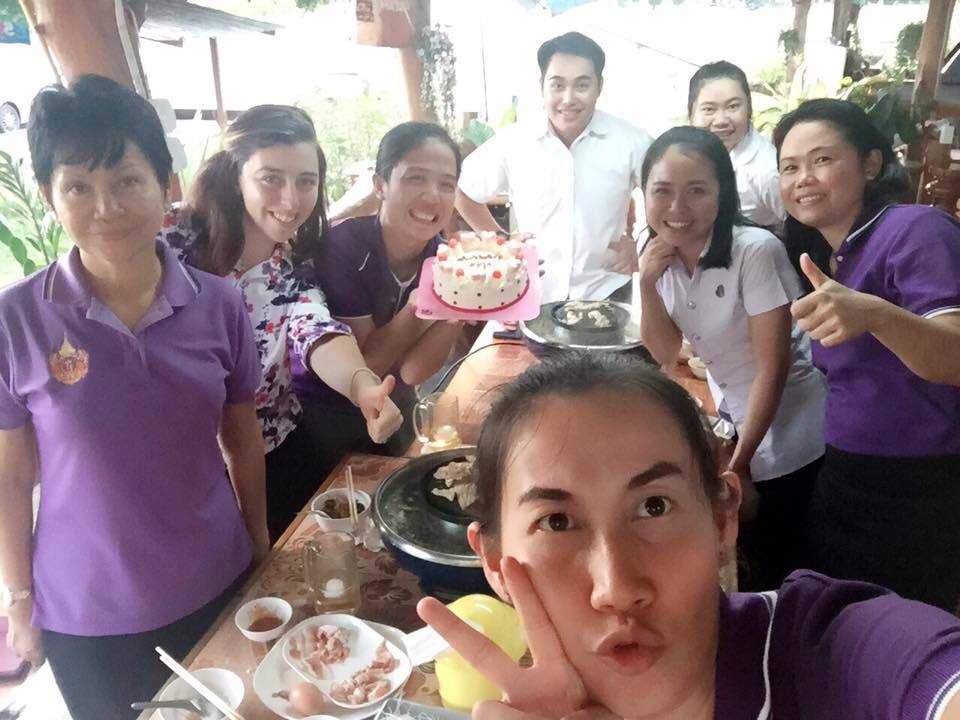
Taking a selfie with a fellow teacher and supporting the Pikachu team.


One night after dinner near the famous 7-11, we saw the varsity soccer students soaking in every minute of sunlight for practice. The sun was setting and the field doesn’t have lights so P'Pui and three other teachers greeted the students. It was quite late and the sun had set, so the teachers kindly told the boys to wrap up their game and head home. Each teacher expressed their concern for the boys’ safety. Though the boys were disappointed to finish playing their beloved soccer, each player respectfully wai-ed** each of us before hopping on their motorbikes and going home. This made me realize that teachers hold a special place in Thai schools.


Teacher dinners include everyone in the department, from the student teachers to the department directors.

As a teacher, I am not limited to teaching in the classroom. In fact, I am encouraged to join soccer practice, lead club activities, support other teacher projects, mentor students applying to university, volunteer at a local orphanage and share music with students after school. The role of ‘teacher’ is akin to an aunt in American culture. This generates a familial environment of support, interconnectedness and healthy honesty to understand important boundaries.

Some people say it takes a village to raise a child, but in my case, I am witnessing an entire school community work as a village. Mae Lao Wittayakom functions as a never-ending circle of mentors and mentees, both within the teachers and students.

Teachers and students look out for each other. Students offer to carry materials for the teachers regularly in exchange for encouragement, while even the slightest eyebrow raise will galvanize a student to hastily tuck in a shirt tail. Experienced teachers dote on younger teachers, mentoring and mothering them during morning assembly and lunch. When one person wins the lottery in the school office, everyone wins.


The interconnectedness at LMK includes the non-humans, too. Our school dog, Lung, has only one eye. About 10 years ago, some students found a little puppy in very poor health. They started a campaign and had fundraised among the student body to save the little puppy. Every day since, Lung has been the ‘school dog’. There's not a day that goes by when I don't see a student buying a hotdog to give to Lung, ensuring he's fed. I wasn’t surprised that everyone banded together again to cover the medical costs when he was regrettably hit by a car. With the collective prayers, extra hot dog treats and a visit to the veterinarian, Lung has recovered and is back in the business of joining English class.


At a teacher and student dinner, our school dog Lung waits patiently for the hot pot leftover.


Whether it’s sports day, a random night after school, or in a challenging time, the sense of collective community and compassion for each other at MLK is heart-warming. To be welcomed into the Mae Lao family has been wholesome. Though I wondered how I might fit into the school family at first, I have consistently been included. With my host teachers, I have been the mentee, English mentor, niece, daughter and friend. With my students, I have been the teacher, mentor, older sister, karaoke partner, soccer practice player, and liaison to American culture. With Lung, I have been the hot dog treat giver and American English slang teacher. Our school family is welcoming, supportive and unassuming and I wouldn’t want to be anywhere else. 


Sunday night "framly" dinner: when your friends become your family, you have a framly 


**Wai is a very important aspect of Thai culture. It is a way to offer respect and acknowledgement to the other person. Typically, younger students "wai" their mentors, teachers and elders.


28 September, 2015

How Ronald McDonald is the Buddha of the Fast-Food World


Tram Kieu is a native Cornhusker hailing from Lincoln, Nebraska. She is a graduate of Nebraska Wesleyan University and earned a BA in Global Studies and a minor in Spanish. Tram is a 2014-2015 ETA Fulbrighter in Kalasin province in northeastern Isaan Thailand. When she is not learning how to sing Isaan songs, Tram enjoys trying new foods with the exception of the voluntary or involuntary ingestion of insects. After her time as a Fulbright ETA, Tram plans to continue dedicating her time to teaching English wherever she is in the world 
and working towards empowering women 
and girls through education.


Ronald Mcdonald and Buddha

If you think about it, monasteries in Thailand are a lot like McDonald’s.

Thai monasteries are ubiquitous throughout Thailand as are McDonald’s restaurants around the globe. Located in almost every nook and cranny, small or big, there are approximately 45,000 monasteries in Thailand. While there are about 36,000 McDonald’s locations in the world, numbers don’t matter as much as the cross-cultural lessons between these two iconic representations of Thai and American cultures.


The cliché selfie with Thai-Ronald McDonald.

First off, when you step into a McDonald’s in Thailand you are greeted by Ronald McDonald in typical Thai fashion: with a smile and hands clasped together to greet you in a wai position.

In Buddhism, the framework of Buddhist practice consists of the Buddha, the Dharma (Buddha’s teachings), and the Sangha (the monastic community). When examining the significance of the Three Jewels from a Big Mac point of view, you could say that Ronald McDonald is a representation of Buddha, the menu would be the Dharma, and the employees the Sangha. Although Ronald McDonald is not as highly revered as Buddha, their images are easily recognizable throughout Thailand and the world.


A handmade clay hagiography of Buddha on a monastery pillar in Chiang Mai.

Buddha images and statues are strewn on almost every conceivable surface in Thailand: on walls, car dashboards, bus windows, or tree trunks usually depicting Buddha wearing a yellow, orange, or saffron-colored robe. Likewise, Ronald McDonald also dons a somewhat similar universal yellow “robe.” He, however, also wears big, red clown shoes and has a head of bright red hair.


 Buddha statues on the roots of a bodhi tree.

When in a foreign country, and especially in Thailand where there are only three seasons: hot, hotter, and very hot, air conditioning in a McDonald’s feels like heaven. Similarly, while some go to McDonald’s to bask in the air conditioning and free wi-fi, others go to monasteries to receive “free spiritual wi-fi.”

But all things considered and humor aside, I chose to write about the topic of Thai Buddhism because religion and daily life go hand in hand in Thailand. More specifically, I chose the topic of funerals because of the importance of Buddhist concepts to understanding life and equally important, death.

Having lived in Thailand as an ETA, I have attended more funerals than I have ever in my life; in fact, I have never once in my life attended a funeral in its entirety. This past year, however, I attended seven funerals in total, two of which were from my own family in Vietnam. These past twelve months have taught me that community and family are synonymous. I have been invited to a plethora of events such as weddings, parades, beauty pageants, monk ordinations, funerals, and even death anniversaries. Whether it is a celebration of life or death, maintaining relationships is the cornerstone of Thai and Vietnamese cultures.

Death is a very somber and often times avoided topic. No one really enjoys talking about death or the feelings associated with the passing of a loved one. When intertwined with Buddhist beliefs, customs, superstitions, and interpretations, it is difficult to decipher what Buddhism is and to what degree it plays a part in Thai culture. I had so many questions and at times, it was difficult for my colleagues and family members to explain the significance behind the Buddhist rituals. Therefore, I took it upon myself to share some key aspects of Buddhist funerals here, specifically, Thai Isaan funerals, compiled from the personal experiences of my Thai colleagues and my own observations, so that others can understand the beautiful metaphors about life.


Wai

To begin, wai-ing is a Thai custom of showing respect when greeting, saying goodbye, showing appreciation, and praying. A wai is said to resemble the shape of a lotus bud formed when two hands are clasped together. The lotus flower is an important symbol in Buddhism as it represents a Buddhist’s journey in life. Because the lotus grows in murky swamps and is still able to blossom into a beautiful, untainted flower, it represents a  person’s growth within society.

Wai-ing will most likely be the first aspect of Thai culture you will learn because greetings and seniority are important in Thai culture. As a result, there are various different wais for different groups of people in terms of age. For instance, a typical greeting from a peer or younger person to an older person would consist of a wai positioned near the chest with a slight bow. To greet a monk, or show respect to an image of the King or Buddha, you would place your wai with the tips of your fingers between your eyebrows. Interestingly, the King does not wai to anyone except to monks, and monks do not wai to anyone unless to show respect to an older monk or to Buddha.


Molly, a Chinese teacher from Kamalasai School, making a blessing after a prayer session.

Ajaan Chinadarat, an English teacher from Kamalasai School, wai-ing during a funeral service.

Water and the belief in reincarnation

Prayer sessions are the focus of every Buddhist funeral in Thailand. During the entirety of a funeral ceremony, merit is created for the deceased through prayers. Each day, prayers are led by four monks chanting in Pali Sanskrit. This merit, or good deeds, will aid in the deceased’s reincarnation for the next life. After the prayer sessions, guests and family will make a blessing and pour water either next to a tree or on the ground as “to return all the goodness and natural elements” back to the earth.

Monks creating merit and chanting during a prayer session.


The number 3

The number three is an auspicious number in Buddhism. It symbolizes the Three Jewels: the Buddha, the Dharma, and the Sangha. When Thais wai to a Buddha image or make a procession around a pagoda, it is typically done three times as to pay homage to the Three Jewels.

Moreover, it is common for funerals to take place three days after the person has passed and last a minimum of three days. Generally, funerals last a total of seven days, however depending on when the person died, the cause of death, the auspicious day for burial, and the deceased family’s monetary situation, funerals can last between three to 100 days.

Additionally, before the cremation ceremony, the last rites of passage will take place and everyone will take part in creating merit one last time for the deceased. A procession of family and friends will walk counterclockwise circling the monastery three times. This procession represents the journey to heaven and family, friends, and monks are escorting the decreased to the next life.


A funeral procession to honor the passing of the former vice-principal at Kamalasai School.

Buddhism is a fundamental aspect of Thai culture and life. To understand Thai cultural values, you must first understand Buddhism. Although Buddhism is not the official religion of Thailand, Buddhist beliefs are very much an integral part of Thailand’s political, cultural, and social fabric--over 94% of Thailand’s population self-identifies as Buddhist. This number is proof that Buddhist teachings are deeply ingrained in daily life, and the reason why there are more Buddhist monasteries in Thailand than there are McDonalds in the entire world.

This past year, I have learned that perhaps the sabai sabai, or the nonchalant approach towards life in Thailand, comes from Thais’ view on death. First, funerals are metaphors of how Thais view their role in life and the afterlife. While the passing of a loved one is always a great loss, life and death should both be celebrated. Second, although death is the last rite of passage, it is also viewed as a passage to the next life. As a result, death is in a way celebrated rather than mourned because of its inevitability and impermanence.


Lastly, relationships are important in Buddhist practices because we experience the same life passages and we are interwoven in the way we conduct ourselves. More importantly, we coexist and live on the same earth. Natural elements such as water and the earth play prominent roles in funeral ceremonies because water represents the continuous momentum of life and the earth represents all the merit that we have accumulated throughout our lives. When guests pour water onto the ground, it is an act of solidarity. It is about renewing life and transferring merit to which we all work to accumulate in our everyday actions, speech, and thoughts.

Whether you are Buddhist, or not, or enjoy eating a Big Mac once in a while, remember that cross-cultural lessons can be learned anywhere in the world, even at a funeral or a McDonald’s.

---------------------------------------------------------------------------------------------------------------------------------------------------

Reference for a description of a Thai Isaan funeral


Day 1 – Bathing rite and San Sai Ceremony: Approximately 30 minutes after the person has passed away, family members will prepare the body to be placed in the coffin. The body will be cleansed and dressed in new clothes, and turmeric powder will be applied. Next, the ceremonial san sai, or blessed unspun white cotton thread, will be tied around the neck, wrists, then feet by the oldest member of the community or the eldest child. Lastly, a coin will be placed in the mouth as to signify the money to be used in the next life.

Day 1-6 – Prayer: Prayer sessions will begin around 7 P.M. each day and will last from 30 minutes to an hour with intervals in between. It is customary for family and guests to dress in black or white attire. During prayer each day, four monks will lead Buddhist incantations in Pali Sanskrit. Each of the four monks represents a superstitious Thai belief about death: 1) sleeping and not waking up; 2) going and not coming back; 3) old friends that could not attend; and 4) illness and not being able to regain back health. After the prayer session, guests will be offered a meal. Food is provided as a way to give thanks to guests for their time, gifts, money donations, and participation in prayer and creating merit for the deceased.

Day 6 – Funeral Service: On the sixth day of the funeral, the last rites of passage will commence and everyone will take part in creating merit one last time for the deceased. Following the procession, a funeral service will be held consisting of prayer, sermons, offering of cloth or robes on behalf of the deceased, and perhaps a traditional Thai dance performance. During prayer, a ribbon or san sai attached to the coffin will be passed among the monks to transfer merit directly to the deceased. Cremation or burial is a personal choice, however in Isaan, cremation is more common.


Depending on the family, the number of monks invited during the funeral service is equivalent to the deceased’s age. A younger male member of the immediate family will usually ordain as a novice monk, the highest form of merit-making.

Soon after, flowers made from sandalwood shavings attached with a candle and incense will be passed out to the guests and to be burned during cremation. The sandalwood flowers are placed under the coffin as to symbolize the communal lighting of the cremation fire. Following, a small booklet is given out with pictures, past accomplishments, and other writing as to share all the good deeds that were done during the deceased’s lifetime.

In addition to the sandalwood flowers, hand folded ribbon flowers with a one baht satang inside are given to guests.

Before the cremation process begins, coconut water is poured over the body and the cremation will take place in the late afternoon after guests have left. The ashes will then be collected in the morning and read for auspicious signs.


The ashes are collected in a white cloth, which symbolizes purity.

Last Day – Last Rites: On the morning of the last day, alms in the form of food will be given to create merit and prayer sessions will continue. Guests will be invited to eat breakfast and then head to the monastery. The next and last ceremony is a prayer ceremony where monks are offered food on the behalf of the deceased. In the final steps, family and friends will pour perfumed oil and sprinkle fragrant flower petals over the ashes. What happens next can vary. Families can keep the ashes at home on an altar or at a monastery to continue merit-making ceremonies until the 50th and 100th day, or scatter the ashes over a body of water.


I would like to thank Ajaan Sompon Chungchaiya, Ajaan Chindarat Photisai, Ajaan Waraporn Suwannasri, and Mali Chongwarin for answering my numerous questions and helping me compile information for this narrative, I could not have done it without you all.


26 August, 2015

My Time in Numbers

Griffin Gosnell is from Phoenix, Arizona. She graduated from Loyola Marymount University (LMU) in Los Angeles with a degree in Psychology and a minor in Art. Griffin is a 2014-2015 Fulbright English Teaching Assistant at Maelao Wittayakom School in Mae Lao, Chiang Rai, Thailand. When she isn't teaching or traveling around beautiful Thailand, she has delved into learning Thai, taking free online courses, practicing yoga, and doodling. Following Fulbright, Griffin will spend time with her much missed family and friends, then she will most likely pursue a Masters degree in Marital and Family Therapy with an emphasis in Art Therapy at her alma mater, LMU.


It's hard to fit the past nearly eleven months into a two page narrative, so I figured I could share with you my time in Thailand in numbers.

Learning Thai is no piece of cake, but keeping track of all my new words has helped me a lot. Highly recommended.

Number of Thai words/phrases in my iPhone notepad: 163 

I try to write down everything new for me. While I haven't been great at learning the Thai alphabet, so I'm unfortunately still illiterate in Thai, I've learned Thai through simply talking to people and writing all my translations - English to transliteration of Thai. And although they may not be perfect, and I probably have never used the correct tones, I'm still able to communicate quite well with the people around me. Additionally, I've found that when I rely on Google Translate, I get translations like: "you're right!" = "koon kwaa." Which literally translates to "you are on the right." Nice try Google, you are not right. The translation I was looking for was "took tong."

Numbers of “wai” I give during a general morning at school: 35

“wai”-ing is a Thai greeting and shows respect. Thais wai to say hello, goodbye, and thank you. A wai consists of a slight bow to the other person with your hands pressed together near your chest, head, or forehead, depending on who you are wai-ing. Generally, you wai anyone older than you, and as one of the younger members of Mae Lao Wittayakom school, I try to wai every other teacher and staff first thing in the morning as a “good morning” greeting.


Students at Mae Lao all lined up for morning assembly and the national anthem.


Number of times I've heard the national anthem: 140
I've most definitely heard the Thai national anthem more than I'll ever hear the American national anthem. And so much so that I can practically sing along during morning assembly, to which the teachers around me snicker as the "farang" (foreigner) sings to the tune of "Plehng Chaat Tai" (Thai National Anthem). The Thai national anthem is played twice a day everyday, once at 8am (or during our school's morning assembly) and once at 6pm.

This wonderful woman kept me well-fed all year round. 


Number of som tams (papaya salad) eaten: probably as many times as I've heard the national anthem played 
As a vegetarian, finding veg-friendly meals at my school has been difficult, but thankfully, I love som tam and I love my som tam lady. Asking if you have eaten or what you're eating is a huge part of conversation in Thailand. And as such, teachers ask me what I'm eating or have eaten for lunch. I reply, "som tam." "Gigi, som tam, again?" They ask. "Tuk wan, tuk wan," (Everyday) I respond. "Aren't you bored of it yet?" They inquire. "Not yet!" And tuk wan, we have this conversation. I'll miss my som tam and my quick Thai chats about my "boring" lunches. I hope I can find me those papaya salad ingredients in the USA.

Number of hours taught: 400 

Now I say approximately, because Thailand is pretty notorious for canceled classes for everything from school cleaning days, the school's birthday, English competitions, sports days, ASEAN days, religious ceremonies, the King's birthday, and more. But while teaching, I have enjoyed many successes but also setbacks. Teaching is hard, especially a second language. Thankfully, my students have been wonderful, and each day I teach, the more fun we have together. I will miss the lovely students of Mae Lao very much and wish them all the most success in everything they do!

Number of massages: 16
When else will I be able to get $6 massages whenever I please?! And plus, teaching is no walk in the park, gotta de-stress every once in a while.

Mae Lao teachers and students after the teachers won the soccer championship!


Number of times I've been told not to eat spicy food: 1
Right after I got slammed in the face with a soccer ball during a student versus teacher game, the only advice I got was "geen pet mai dai" (you cannot eat spicy food). I am a lover of all things spicy, so this advice was... Not what I wanted to hear, but also confusing. Why can’t I eat spicy food?! What I hadn't thought of was the ball slamming my teeth into my lips and breaking the skin a bit, so the teachers were worried it would sting. I went on to eat some pad see ew without spicy peppers for the first time that night.... I healed quickly and quickly resumed eating spicy everything. And as always, I was very thankful for the kindness and caring of all the teachers around me!

Number of international meals shared: 4
Whether Mexican or Italian, I have really enjoyed cooking meals to share with my fellow teachers. Foods such as tacos and pizza are hard to come by in Mae Lao (as in don't exist), so it has been fun sharing a part of my life with them.

Number of times this pescatarian (vegetarian who eats eggs, dairy products, and fish) has eaten things outside of the scope of her diet: too many.
Now, I have to admit, some of these were by ....choice? If you can call it that. I've eaten a HUGE scorpion, a deep fried frog, tons of unintentional pork, live wasp larvae, grasshoppers, and crickets, oh my!

Number of ants eaten unintentionally: enough for forever (still haven't eaten any intentionally) 

During internship month, I lived in Khao Sok national park. Bugs had no mercy there. And one day while eating my honey toast, I was so delighted at how yummy it was that I scarfed one slice down so fast that I didn't even realize that all the "wheat specks" that I thought I was seeing were actually teeny tiny ants that had found their way to the deliciousness of the honey. And then to my belly.

Number of countries seen: 4
Myanmar, Cambodia, Indonesia, and Thailand, duh! All four of these countries, although in close proximity, have such amazingly different cultures, foods, and languages. They all made me fall in love in different ways. In Myanmar, I would suggest eating Tofu Oon, an incredible tofu soup in the Shan State that I still dream about today. In Cambodia, I would recommend seeing the Phare Circus – absolutely incredible – a true testament to how far they have come since the Khmer Rogue. In Indonesia, don’t miss the laid back Gili Islands where you can relax, surf, or, my favorite, scuba dive. And in Thailand, make sure to engage with the Thais – I have never been met with as much hospitality as I have here and will truly miss the smiles I see everyday. It certainly isn’t called the Land of Smiles for no reason!


Number of times I've had to stop a bus for emergency toilet stops: 4
Road trips with a colon disease are hard, but thank goodness for the good ole "tong sia" trick, which literally means "broken stomach." You can infer the rest.

Number of Thai provinces visited: 14
I have had the privilege of traveling nearly every weekend in my time in Thailand. Usually just to neighboring Chiang Rai or Chiang Mai, but I try to go further on all my long weekends.

The difference between hottest and coldest temperatures: 50 (in Farenheit)
It was so cold during the winter that students built fires outside of my outdoor classrooms. And so hot that... just take my word for it, it can be so hot.

Spirit + smiles + lots of singing = successful English camp!
Number of English camps participated in: 2 (so far) 
English camps are a great way to get students excited about learning English and get me to understand how hard it is to dance and sing on a microphone at the same time – the Hokey Pokey is a lot harder than it looks. Respect, Beyoncé, respect.

Number of blog entries written: 26
As an extrovert living in rural Thailand, writing in my blog to share my experience with family and friends has been a way for me to connect regardless of how far away I am from home.

Number of books read: 5
Shhh... Now I know what you're thinking, "I read five books a month!" Well, I'm a non-reader, so this is big for me. So let me bask in my five-book glory.

Number of photos taken: 4,704
And these are only the ones currently on my computer... being a procrastinator, I still haven't uploaded many on my camera's SIM card, oops! I take so many that I have to delete a million pictures every time I want to take one!

That's me planting a coconut tree at school!


Number of trees planted: 2
After a devastating earthquake in 2014, my school is still in the process of repairing old things and building new buildings. Planting trees to help in this rebuilding process is something that I've had the opportunity to do not only once but twice since I've been here!

Me and fellow ETA, Michelle, at 30 meters down under in Koh Tao.

Number of meters I've gone under the ocean: 30 
Over travel month, I had the opportunity to go scuba diving. One of the most incredible experiences of my life hands down. It's literally a whole new world. And you're breathing underwater?! Definitely recommended if you ever get the chance.

Number of seconds a day: 300ish
For over two years, I have been capturing my life everyday with one second video clips (there's an exception where my phone shattered, you'll see it in there… and some days where I’m human and I forget, womp womp.).

With each second from nearly every day since I packed up in Phoenix, AZ to now, I hope to share with you a piece of my time here—my students, my fellow teachers, my friends, insects, landmarks; sunset captured; lessons taught; meals cooked—as a Fulbright ETA in Thailand.


one second everyday from Griffin Adwoa Gosnell on Vimeo.

21 August, 2015

From Market to Mat


Michelle McNamara is from Philadelphia, Pennsylvania. She graduated from Villanova University in 2012 with a Bachelor of Arts degree in Communication. After graduating, Michelle taught 4th and 5th grade through Teach For America in New Orleans, Louisiana. Outside of the classroom, Michelle plays beach volleyball, enjoys running, and cooks all possible Thai dishes imaginable. She is currently teaching at Choom Chon Ban Fon Wittaya outside of Lampang.


“Yenee tam arrai?” My favorite vegetable saleswoman said, asking me what I planned to cook that evening. I arrived at the market around my usual time at 5:30 PM. Sometimes, this is too late as popular food items, such as cilantro and mint are already sold out. But I view this as a creative challenge and end up making substitutions like ginger for chilies, cucumber for papaya, or pork for chicken.


My favorite market stand and vendor.

The Ban Fon market is large. One corner is dedicated to live fish swimming in buckets and another corner looks like a free pig-anatomy class. In the outdoor section there appears to be an elaborate game of “Can you tell the differences between eight types of rice?” I cannot.

 Various types of rice at the market. 

Each section is manned, or I should say wo-maned because women make up the majority of shopkeepers, by vendors who without fail, ask me what I’m making each night. Usually my response earns a “Gaeng mak!” or “Very good!” as I hope I’ve been correctly translating in my head for the past ten months…


But today, when I stood in front of my veggie lady, I was a little hesitant to announce my intended dish. I received some raised eyebrows from fellow teachers at my school when I mentioned my culinary quest to make Khao Soi, a curry noodle dish local to Northern Thailand that involves many ingredients, a roasted curry paste, and deep fried noodles. It was also a Tuesday, meaning my weekly “Eat Food and Speak English” dinner club members would be sampling this dish. That was intimidating.

My two neighbors, Riam and Dee, at our weekly Tuesday night English Language dinner.

“Tam Khao Soi?” I said uncertainly. I watched the whispers pass down the row. News, any news, seems to spread very quickly in small communities and it was interesting to watch the whispers pass from mouth to ear. As it turned out, this instantaneous spreading of knowledge made my market trip much easier than usual. My vegetable salesfriend quickly gathered the Khao Soi ingredients, seven vegetables and spices whose names I hadn’t yet committed to memory in Thai, that she could provide and pointed me to my next stop, egg noodles. I bounced from egg noodles (And my discovery that the market had a refrigeration section!) to the woman who specialized in pickled Chinese cabbage (she received the most points in her direction meaning her cabbage was probably the most delicious) to the chicken stand. A couple weeks before this trip, the saleswoman at this stand breached our language barrier by grabbing her chest to teach me the word for “chicken breast.” The market is a classroom unlike any other. 


I traveled home with my ingredients, my grocery sack full of turmeric, garlic, cilantro, dried chilies, ginger, chicken, egg noodles, pickled Chinese cabbage, limes, shallots, and coconut milk.


Me with my motor and pestle, a necessary tool for making curry paste!

I smashed the garlic with a wedge knife and peeled the turmeric with a tiny knife. I grabbed the chilies between my index finger and thumb to prepare them for chopping. I itched somewhere near my eyes. 

Regret. My face burns like the heat of 1,000 suns. 

I roasted all the curry paste ingredients in aluminum foil while preparing the deep fry noodles. My face also roasted. I temporarily hate chilies. 

In another pan, I battled against the heat sensor of my induction cooker. 

The oil got hot, yay! Noodles fried, oil splashed. The induction cooker overheated and switched itself off. I turned the cooker back on. The oil got hot, yay! The induction cooker overheated and switched off again. I groaned.

Following a combination of the various online recipes, I added curry paste, coconut milk and chicken stock to the wok one by one. I boiled egg noodles al dente. I dried some of the oil from the crispy noodles, still hot from deep frying. I placed the plate of Chinese cabbage, lime quarters, and sliced shallots on my yoga mat, or on Tuesday nights, the makeshift dinner table.


The finished product!

When my diners arrived, I assembled the dish. “Hey, it looks good at least?” I thought to myself. I served them their bowls and then like a totally calm, relaxed, and collected chef…I stared at their faces without blinking and waited for a sign of disgust. It never came.

Arroi” my neighbor said, giving me her verdict. 
“Hey this is English language night!” I replied. 
“Delicious!” she uttered, taking another bite.